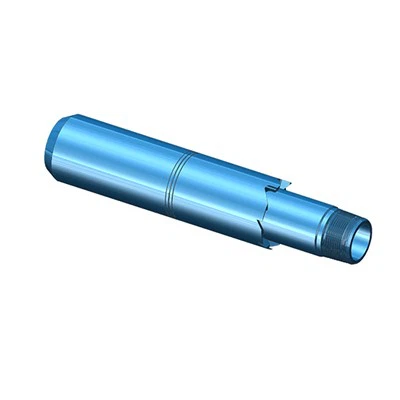
Product Introduction
The Wireline Set Cement Retainer is a retrievable or drillable downhole tool specifically designed for wireline conveyance and setting, mainly used in remedial cementing operations, zone isolation, squeeze cementing, and temporary or permanent well abandonment projects. It is deployed into the wellbore via wireline, set securely at the predetermined depth through surface-controlled pressure activation, and forms a reliable pressure-tight seal between the tool and the casing inner wall. This tool effectively traps squeeze pressure on the cement below the retainer, isolates the newly cemented zone from the hydrostatic pressure above, and prevents cement slurry from flowing back, ensuring the quality of cementing operations. With a compact design, easy running, and drillable components, it can be quickly removed after completion of cementing work without affecting subsequent well operations, making it a cost-effective and efficient solution for oilfield well intervention.
Product Features
1.Secure Wireline Setting & Anti-Preset Design : Deployed and set via wireline pressure setting assembly (WPSA) and wireline adapter kit (WLAK), the tool can be accurately positioned at the target depth with surface control, eliminating the need for drill pipe or coiled tubing, which significantly reduces running time and operational costs. The case-hardened one-piece slips and pinned cones effectively prevent premature setting during deployment, ensuring stable and reliable setting in any hardness casing, including premium grades.
2.Superior Sealing Performance : Equipped with a one-piece packing element and rocker-action metal backup rings, the tool forms a tight and durable seal between the retainer and the casing, capable of withstanding high differential pressure up to 10,000 psi (69 MPa). The surface-controlled valve automatically closes when the stinger is removed, locking in the squeeze pressure and preventing cement slurry backflow, ensuring the integrity of zone isolation.
3.Drillable & Easy Cleanup : Constructed with high-quality cast iron components that are rotationally locked, the retainer can be easily drilled out using standard PDC bits after cementing operations, saving rig time and reducing cleanup costs. The drillable design ensures no residual tool components remain in the wellbore, avoiding interference with subsequent production or well intervention operations.
4.Wide Compatibility & Versatility : Available for casing sizes from 4 1/2" to 13 3/8", covering most common oilfield casing specifications, and compatible with Baker wireline setting tools without the need for crossovers. It can be easily converted to a wireline set bridge plug or mechanical set cement retainer with a simple conversion kit, adapting to multiple operational needs such as zone isolation, multi-zone stimulation, and well abandonment.
5.High Temperature & Pressure Resistance : Engineered to withstand downhole temperatures up to 400°F (204°C) and pressures up to 10,000 psi, the tool maintains stable performance in harsh downhole environments (high salinity, corrosive media, deviated wells). The high-quality materials and precision manufacturing ensure long service life and reliable operation, reducing maintenance frequency and downtime.
6.Pressure Test Capability : Allows pressure testing of the retainer and tubing string before cementing operations, enabling operators to verify the sealing performance and structural integrity of the tool in advance, avoiding potential risks during formal construction.
Working Principle
The Wireline Set Cement Retainer operates through a simple and reliable surface-controlled mechanism, with the following key working steps :
- Deployment : The retainer is connected to the wireline pressure setting assembly (WPSA), wireline adapter kit (WLAK), and snap latch stinger sub, then lowered into the wellbore via wireline to the predetermined depth.
- Setting Activation : Once reaching the target depth, the WPSA is actuated from the surface. The tension mandrel moves upward, pulling the retainer body relative to the setting sleeve of the WLAK, which drives the slips to expand outward and bite into the casing inner wall, securing the retainer in place.
- Seal Formation : As the setting process proceeds, the one-piece packing element compresses and deforms, forming a tight seal between the retainer and the casing. The ratchet lock ring stores the setting force, maintaining the pack-off effect even during pressure reversals.
- Setting Assembly Retrieval : Continued upward movement of the tension mandrel closes the control latch inside the retainer. When the shear stud is sheared, the setting assembly (WPSA and WLAK) is retrieved, leaving the retainer securely set in the wellbore.
- Cementing Operation : Cement slurry is pumped through the stinger into the target zone. After cementing, the stinger is removed, and the surface-controlled valve automatically closes, locking in the squeeze pressure and isolating the cemented zone from the upper hydrostatic pressure.
- Post-Cementing Cleanup : Once the cement is fully cured, the retainer can be easily drilled out using standard drilling tools, completing the entire operation without leaving residual components in the wellbore.
Installation & Operation Guidelines
To ensure the safe and efficient operation of the Wireline Set Cement Retainer, please follow the following installation and operation guidelines (detailed operation manual will be provided with each product) :
- Pre-Installation Inspection : Check the tool for damage, corrosion, or missing components (slips, packing element, shear studs, etc.). Verify that the tool specifications match the casing size and operational requirements. Test the sealing performance of the packing element and the flexibility of the slips.
- Tool Assembly : Connect the retainer to the wireline pressure setting assembly (WPSA), wireline adapter kit (WLAK), and snap latch stinger sub according to the assembly diagram. Ensure all connections are tight and secure to prevent disconnection during deployment.
- Deployment : Lower the assembled tool into the wellbore via wireline at a steady speed, avoiding rapid lowering to prevent tool damage or premature setting. Monitor the depth in real time to ensure accurate positioning at the target depth.
- Setting Operation : Once the tool reaches the target depth, actuate the WPSA from the surface to start the setting process. Monitor the surface pressure and tension data to confirm that the slips are fully expanded and the packing element is tightly sealed. Ensure the ratchet lock ring is properly engaged to maintain the setting force.
- Setting Assembly Retrieval : After the setting is completed, continue to apply tension to shear the shear stud, then retrieve the WPSA and WLAK. Verify that the retainer remains securely set in the wellbore by monitoring the wireline tension.
- Cementing Operation : Pump the cement slurry through the stinger into the target zone according to the designed parameters. After cementing, slowly remove the stinger, ensuring the surface-controlled valve closes automatically to lock in the squeeze pressure.
- Drill-Out Operation : After the cement is fully cured (usually 24-48 hours), use a PDC bit to drill out the retainer. Monitor the drilling parameters to ensure smooth drill-out without damaging the casing.
Application Scenarios
- Remedial Cementing : Ideal for squeeze cementing operations to repair casing leaks, seal annular channels, and improve cement bond quality, effectively solving the problem of poor cementing in primary cementing operations.
- Zone Isolation : Used for temporary or permanent isolation of production zones, water zones, or gas zones, preventing fluid窜流 between zones and ensuring efficient and safe production of oil and gas wells.
- Well Abandonment : Provides a reliable barrier for permanent well abandonment, isolating the wellbore from the surrounding formation to prevent environmental pollution and ensure operational safety.
- Multi-Zone Stimulation : Assists in multi-zone stimulation operations by isolating different zones, ensuring that stimulation fluid acts on the target zone accurately, improving stimulation efficiency.
- Directional & Horizontal Wells : Suitable for directional, deviated, and horizontal wells, as no rotation is required for setting or release, adapting to complex wellbore trajectories.
FAQ
Q: What is the difference between Wireline Set Cement Retainer and Mechanical Set Cement Retainer?
A: The core difference lies in the deployment and setting method. The Wireline Set Cement Retainer is deployed via wireline and set by surface-controlled pressure activation, which is more efficient, requires no drill pipe/coiled tubing, and is suitable for wells where drill pipe access is difficult. The Mechanical Set Cement Retainer is deployed via drill pipe or tubing and set by mechanical compression, which is more suitable for large-scale cementing operations. Our Wireline Set model can be easily converted to a mechanical set version with a simple conversion kit, offering greater versatility.
Q: Can the Wireline Set Cement Retainer be reused?
A: It depends on the design type. Our standard model is a drillable, non-reusable type, which is drilled out after cementing operations to avoid residual components in the wellbore. We also offer retrievable versions that can be retrieved via wireline after completion of operations, suitable for temporary isolation scenarios. Please specify your needs when placing an order.
Q: What casing sizes is the Wireline Set Cement Retainer compatible with?
A: Our standard models are compatible with casing sizes from 4 1/2" to 13 3/8", covering most common oilfield casing specifications. Custom sizes can be designed and manufactured according to your specific casing size requirements, including special casing grades and non-standard sizes.
Q: How to ensure the sealing performance of the retainer in high-pressure downhole environments?
A: We adopt a one-piece packing element combined with metal backup rings to enhance sealing reliability, which can withstand differential pressure up to 10,000 psi. The ratchet lock ring stores the setting force, maintaining the pack-off effect even during pressure reversals. Additionally, we conduct strict pressure testing on each product before delivery to ensure the sealing performance meets the design standards. You can also perform on-site pressure testing before cementing operations to further verify the seal integrity.
Q: How long does it take to drill out the retainer after cementing?
A: The drill-out time depends on the casing size, retainer material, and drilling equipment. Generally, for standard casing sizes (4 1/2" to 8 5/8"), the drill-out process can be completed in 30-60 minutes using a PDC bit. The cast iron construction of the retainer ensures easy and fast drill-out, saving rig time and operational costs.
Q: Is the Wireline Set Cement Retainer compatible with all wireline setting tools?
A: Our retainer is designed to be compatible with Baker-style wireline setting tools, including wireline pressure setting assemblies (WPSA) and wireline adapter kits (WLAK), and can be connected directly without the need for crossovers. If you use other brands of wireline setting tools, we can provide custom adapter components to ensure compatibility. Please provide the model of your wireline tools when consulting.
Q: What is the maximum temperature and pressure the retainer can withstand?
A: Our standard Wireline Set Cement Retainer can withstand a maximum temperature of 400°F (204°C) and a maximum pressure of 10,000 psi (69 MPa). For wells with higher temperature and pressure requirements (e.g., high-temperature deep wells), we can customize the tool with high-temperature resistant materials and enhanced pressure-bearing structures to meet your specific operational needs.
Q: Do you provide after-sales service and technical support?
A: Yes, we provide comprehensive after-sales service and technical support. Each product is accompanied by a detailed operation manual and quality inspection report. Our professional technical team can provide on-site installation guidance, operational training, and troubleshooting support. If you encounter any problems during use, please contact us, and we will respond within 24 hours to provide solutions.
Hot Tags: wireline set cement retainer, China wireline set cement retainer manufacturers, suppliers, factory, On Off Tool, Equalizing Check Valve, Tubing Anchor Catcher, Wireline Setting Tools, drilling tools, Tubing Anchor
|
Casing Size (in) |
Casing Weight Range (lb/ft) |
Tool OD (in) |
Minimum ID (in) |
Maximum Pressure Rating (psi/bar) |
Maximum Temperature Rating (°F/°C) |
Material |
Elastomer Option |
|---|---|---|---|---|---|---|---|
|
4 1/2 |
9.5 - 16.6 |
3.826 - 4.090 |
3.580 |
10,000 / 689.48 |
400 / 204 |
Cast Iron / Carbon Steel |
Nitrile / HNBR / Viton |
|
5 |
11.5 - 20.8 |
4.156 - 4.560 |
3.940 |
10,000 / 689.48 |
400 / 204 |
Cast Iron / Carbon Steel |
Nitrile / HNBR / Viton |
|
5 1/2 |
13.0 - 23.0 |
4.670 - 5.044 |
4.310 |
10,000 / 689.48 |
400 / 204 |
Cast Iron / Carbon Steel |
Nitrile / HNBR / Viton |
|
7 |
17.0 - 35.0 |
6.004 - 6.538 |
5.690 |
10,000 / 689.48 |
400 / 204 |
Cast Iron / Carbon Steel |
Nitrile / HNBR / Viton |
|
8 5/8 |
24.0 - 49.0 |
7.511 - 8.097 |
7.125 |
8,000 / 551.58 |
400 / 204 |
Cast Iron / Carbon Steel |
Nitrile / HNBR / Viton |
|
10 3/4 |
32.7 - 60.7 |
9.660 - 10.192 |
9.437 |
5,000 / 334.74 |
400 / 204 |
Cast Iron / Carbon Steel |
Nitrile / HNBR / Viton |
|
13 3/8 |
48.0 - 72.0 |
12.347 - 12.715 |
12.000 |
3,000 / 206.84 |
400 / 204 |
Cast Iron / Carbon Steel |
Nitrile / HNBR / Viton |