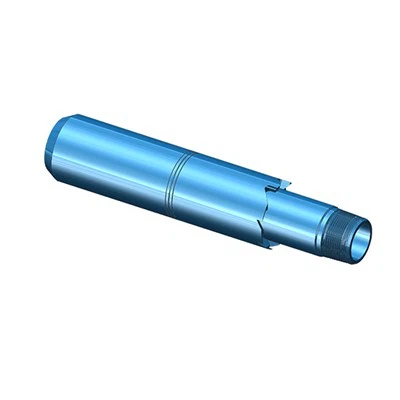
Product Introduction
Our ECV features a compact, non-locking design that seats on the no-go shoulder of landing nipples, with a built-in equalizing mandrel port for pressure equalization prior to retrieval. It is compatible with standard running (C-1) and pulling (SB) tools, ensuring seamless integration with existing wireline or tubing deployment systems.
The Equalizing Check Valve (ECV) is a specialized downhole tool designed to permit unidirectional flow (upward) while blocking reverse flow (downward), with an integrated equalizing mechanism to equalize pressure across the valve before retrieval. It is specifically engineered for installation in tubing-mounted landing nipples (e.g., F Nipple/FB2 seats, R Nipple/RB2 seats) and is commonly referred to as a "Standing Valve" in electric submersible pump (ESP) and gas lift applications.
Product Features
1.Unidirectional Flow with Positive Sealing : Engineered to allow full upward flow while providing a positive seal against downward reverse flow, preventing backflow and protecting downhole pumps (e.g., ESPs) and surface equipment from fluid surge and reverse torque.
2.Integrated Pressure Equalization : Built-in equalizing mandrel ports enable pressure equalization across the valve before retrieval, eliminating the need for additional equalization tools and simplifying retrieval operations.
3.Universal Nipple Compatibility : Designed to fit standard F Nipple (FB2 seats, top no-go shoulder) and R Nipple (RB2 seats, bottom no-go shoulder) profiles, ensuring broad compatibility with common landing nipple systems.
4.Low Flow Restriction : Full-port flow path minimizes pressure drop and flow resistance, maintaining optimal fluid flow for gas lift, well cleanout, and production operations.
5.HPHT & Corrosion Resistance : Constructed from high-strength alloy steel (AISI 4140/4130) with heat treatment and corrosion-resistant coatings, with a maximum temperature rating of 350°F (177°C) and pressure rating up to 5,000 psi (34.5 MPa), ensuring reliable performance in harsh downhole environments.
6.Tool-Free Deployment & Retrieval : Compatible with standard C-1 Running Tool and SB Pulling Tool, requiring no special adapters or equipment, reducing operational complexity and costs.
7.Versatile Application : Suitable for gas lift operations, ESP standing valve service, tubing pressure testing, hydraulic packer setting, and well intervention tasks, serving as a multi-functional solution for various well systems.
8.Cost-Effective & Reusable : Robust construction supports multiple runs under normal operating conditions, reducing the need for frequent replacements and lowering long-term maintenance expenses.
Working Principle
The Equalizing Check Valve operates on a simple yet reliable mechanical mechanism, with three core operational phases :
- Deployment & Installation
The ECV is run into the tubing-mounted landing nipple using a standard C-1 Running Tool, lowered to the desired depth, and seated on the no-go shoulder (FB2 for F Nipple, RB2 for R Nipple). During deployment, the valve remains in a closed (reverse-flow blocking) position to prevent unintended fluid backflow, ensuring safe installation.
- Normal Operation (Unidirectional Flow)
During production, gas lift, or well cleanout, upward fluid pressure acts on the valve element, lifting it to open the full port and allow unobstructed flow. The valve element is spring-loaded (or weighted) to return to the closed position when upward flow ceases, providing a positive seal against downward reverse flow and preventing fluid backflow into the wellbore or surface system.
- Pressure Equalization & Retrieval
Prior to retrieval, the equalizing mandrel port is shifted open (via the running/pulling tool), equalizing pressure across the valve and eliminating pressure differentials that could resist retrieval. Once pressure is equalized, the standard SB Pulling Tool is used to retrieve the ECV from the landing nipple, completing the operation efficiently.
Installation & Operation Guidelines
To ensure safe, efficient operation, follow these guidelines (a detailed operation manual is provided with each unit) :
- Pre-Installation Inspection
Inspect the ECV for damage, corrosion, or missing components (valve element, spring, equalizing mandrel, seals).
Verify compatibility with the landing nipple profile (F/R Nipple) and tubing size.
Test the valve's open/close function and equalizing mechanism to ensure proper operation.
- Deployment
Attach the ECV to the C-1 Running Tool and lower it into the landing nipple at a steady speed (≤30 ft/min).
Seat the valve firmly on the no-go shoulder (FB2/RB2) and confirm proper positioning.
Avoid rotating the tool string during deployment to prevent misalignment.
- Operation
For production/gas lift: Allow upward flow to open the valve and maintain unobstructed flow.
For pressure testing: Use the ECV to isolate the tubing string and perform pressure tests as required.
Monitor surface pressure to ensure the valve is sealing correctly and no reverse flow is occurring.
- Retrieval
Prior to retrieval, activate the equalizing mandrel port to equalize pressure across the valve.
Attach the SB Pulling Tool and retrieve the ECV at a steady speed, ensuring no resistance during retrieval.
After retrieval, inspect the ECV for wear, damage, or seal degradation, and perform maintenance as needed.
- Maintenance
Clean the ECV thoroughly to remove mud, debris, and corrosive deposits.
Inspect the sealing element, spring, and equalizing mandrel for wear; replace worn components as needed.
Store the ECV in a dry, clean environment to prevent corrosion and ensure long-term reliability.
Application Scenarios
- Electric Submersible Pump (ESP) Systems : Serves as a Standing Valve to prevent fluid backflow when the pump is stopped, protecting the ESP from reverse torque and damage, and simplifying pump retrieval via pressure equalization.
- Gas Lift Operations : Regulates upward flow during gas lift operations, ensuring efficient gas injection and production while blocking reverse flow to maintain wellbore pressure stability.
- Tubing Pressure Testing : Acts as a pressure test plug to isolate the tubing string, enabling accurate pressure testing to verify integrity and identify leaks before production starts.
- Hydraulic Packer Setting : Installed below hydraulic packers to support setting operations, with unidirectional flow ensuring proper pressure application while preventing reverse flow that could compromise packer integrity.
- Well Intervention & Cleanout : Facilitates well cleanout and fluid circulation, with low flow restriction ensuring efficient debris removal while protecting downhole tools from backflow damage.
- Well Abandonment & Plugging : Supports permanent well closure by providing a reliable flow barrier, ensuring no fluid migration between wellbore zones.
FAQ
Q: What is the difference between an Equalizing Check Valve (ECV) and a standard check valve?
A: The key difference is the integrated pressure equalization mechanism. Standard check valves only provide unidirectional flow but lack the ability to equalize pressure across the valve before retrieval. Our ECV includes a built-in equalizing mandrel port that equalizes downhole pressure, simplifying retrieval without the need for additional tools or operations, reducing NPT and improving efficiency.
Q: Can the ECV be reused, and what is its service life?
A: Yes, our ECV is fully reusable. Under normal operating conditions with proper maintenance, it can be reused for multiple runs (typically 5–8 cycles). The service life depends on downhole conditions (temperature, pressure, corrosion) and maintenance practices. Regular inspection and replacement of sealing elements will extend its operational life.
Q: Which landing nipple profiles is the ECV compatible with?
A: Our standard ECV models are compatible with F Nipple (FB2 seats, top no-go shoulder) and R Nipple (RB2 seats, bottom no-go shoulder) profiles, which are widely used in tubing-mounted landing nipple systems. Custom versions for non-standard profiles are available upon request.
Q: How does the pressure equalization process work, and why is it important?
A: Prior to retrieval, the equalizing mandrel port is shifted open, allowing fluid to flow between the upper and lower sides of the valve element, equalizing pressure across the valve. This eliminates the pressure differential that could resist retrieval, making the retrieval process smooth and effortless, reducing the risk of tool sticking or damage.
Q: Can the ECV be used in high-pressure/high-temperature (HPHT) wells?
A: Yes, our standard ECV is rated for up to 5,000 psi (34.5 MPa) and 350°F (177°C), making it suitable for most HPHT well conditions. For ultra-HPHT environments (temperature >350°F or pressure >5,000 psi), we offer custom models with high-temperature materials (e.g., Inconel) and enhanced pressure-bearing structures to meet specific requirements.
Q: What is the maximum flow rate the ECV can handle?
A: The flow rate capacity depends on the tubing size and port design. Our full-port ECV minimizes flow resistance, with flow rates ranging from 50 to 300 GPM (gallons per minute) depending on the tubing size. For example, a 2 3/8" (2.375 in) tubing size ECV can handle up to 100 GPM, while a 2 7/8" (3.5 in) size can handle up to 300 GPM. Custom port sizes are available to meet specific flow requirements.
Q: Does the ECV require special tools for deployment and retrieval?
A: No. Our ECV is designed for compatibility with standard industry tools: it uses the C-1 Running Tool for deployment and the SB Pulling Tool for retrieval, requiring no special adapters or equipment. This reduces operational complexity, lowers costs, and ensures seamless integration with existing wireline or tubing systems.
Q: Can the ECV be used in H₂S/CO₂ corrosive well environments?
A: Yes, we offer H₂S/CO₂-resistant versions of the ECV. These models use corrosion-resistant alloy steel (e.g., 13Cr, Inconel) for the body and special elastomers (e.g., Viton) that are resistant to sour gas and corrosive media, ensuring stable performance in harsh downhole conditions. Please specify your well's H₂S/CO₂ content when ordering for custom configuration.
Q: How does the ECV prevent reverse flow, and what is its sealing performance?
A: The ECV uses a spring-loaded (or weighted) valve element that provides a positive seal against downward reverse flow. The sealing element (HNBR/Viton) forms a tight, leak-tight seal when the valve is closed, preventing fluid backflow. Each unit undergoes strict pressure testing (per API 598) before shipment to ensure no visible leakage under operating conditions.
Q: Do you provide technical support and after-sales service for the ECV?
A: Yes, we offer comprehensive technical support and after-sales service. Each ECV comes with a detailed operation manual, quality inspection report, and installation guide. Our professional technical team provides on-site guidance, operational training, and troubleshooting support. If you encounter issues (e.g., retrieval resistance, sealing failure), we respond within 24 hours to provide solutions. We also offer maintenance kits and replacement parts to ensure long-term performance.
Hot Tags: equalizing check valve, China equalizing check valve manufacturers, suppliers, factory, drilling tools, Liner Pipe, Profile Nipple, Casing And Casing Pup Joint, Hydraulic Anchor, Circulation Valve
| Item | Specification | Notes |
|---|---|---|
| Tubing Size (in) | 1.812 – 3.5 | Compatible with 2 3/8" to 2 7/8" tubing strings |
| Seal OD (in) | 1.781 – 2.865 | Matches landing nipple seal profiles |
| Max OD (in) | 1.802 – 2.802 | Ensures passage through wellbore restrictions |
| Max Pressure Rating (psi/MPa) | 5,000 / 34.5 | API-compliant pressure rating |
| Max Temperature Rating (°F/°C) | 350 / 177 | Suitable for HPHT well conditions |
| Nipple Profile Compatibility | F Nipple (FB2), R Nipple (RB2) | Universal fit for standard landing nipples |
| Body Material | AISI 4140/4130 Alloy Steel | Heat-treated for strength and corrosion resistance |
| Sealing Element | Elastomer (HNBR/Viton) | Resistant to oil, gas, and corrosive media |
| Flow Direction | Upward (unidirectional) | Positive seal against downward flow |
| Running Tool | C-1 Running Tool | Standard deployment equipment |
| Pulling Tool | SB Pulling Tool | Standard retrieval equipment |