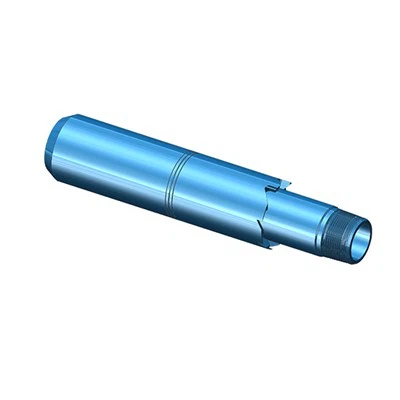
Product Introduction
Our TAC is fully compatible with vertical wells, deviated wells, horizontal wells, and high-angle wells, and can be customized to adapt to high-temperature, high-pressure (HTHP), and sour gas well conditions with H₂S and CO₂.
It effectively anchors the downhole tubing string to the casing inner wall, eliminating axial creep, expansion and contraction of the tubing caused by formation pressure fluctuations and reciprocating motion of the pumping unit. This drastically reduces eccentric wear between the sucker rod and tubing, extends the service life of the production string and downhole pump, and improves overall pumping efficiency. Meanwhile, the built-in high-sensitivity catcher mechanism can instantly lock and catch the tubing string in the event of accidental fracture or decoupling, preventing catastrophic tubing fall-in accidents, minimizing workover costs, and reducing unplanned production downtime.
Product Features
1.2-in-1 Integrated Design : Combined anchoring and catching functions eliminate the need for separate downhole tools, enabling one-trip string running, shortening operation cycles, and reducing overall wellsite operation costs.
2.High-Reliability Bi-Directional Anchoring Mechanism : Premium high-strength slip design delivers superior gripping force on the casing inner wall, maintaining stable anchoring under alternating loads and pressure fluctuations, with zero string slippage even in harsh downhole environments.
3.Sensitive & Reliable Catching System : Built-in spring-loaded catcher claw mechanism with ultra-fast trigger response and wide catching range, effectively securing broken tubing strings to avoid complex fishing operations and major downhole accidents.
4.Full-Bore, Low-Flow Resistance Design : Optimized internal flow channel with full-bore structure ensures unobstructed flow of wellbore fluids, minimizes throttling loss, and allows smooth passage of coiled tubing, logging tools and other downhole equipment.
5.High-Strength Corrosion-Resistant Materials : Main body is manufactured from premium alloy structural steel (4140H/4130H) as standard, with optional 410 stainless steel, 316L, and duplex steel for corrosive environments. Special surface hardening and anti-corrosion treatment ensures long-term performance in H₂S/CO₂-containing sour wells, compliant with NACE MR0175 standards.
6.Easy Installation & Release, User-Friendly Operation : Standard API thread connections are fully compatible with conventional tubing strings, no special operation tools required. Supports both right-hand rotation setting and hydraulic setting, with simple forward/reverse release, reducing on-site operation difficulty and labor costs.
7.Superior Fatigue Resistance : All products undergo strict fatigue testing and full-scale load verification, withstanding long-term reciprocating loads and alternating pressure in rod pump production operations, maintaining stable performance throughout the entire production cycle.
Working Principle
Our Tubing Anchor Catcher consists of four core modules: anchoring mechanism, catcher mechanism, release mechanism, and main body sub. Its working process is divided into three stages: running & setting, production operation, and release & retrieval.
- Running & Setting Operation : The TAC is run into the well with the tubing string to the designed setting depth. For mechanical TAC, clockwise rotation of the tubing string drives the slips to extend outward and firmly engage with the casing inner wall, completing bi-directional anchoring. For hydraulic TAC, setting is achieved by pressurizing the tubing string to the designed pressure and holding, eliminating the need for string rotation.
- Production Operation Stage : After setting, normal production operations (oil production, water injection, etc.) can be carried out. During production, the anchoring mechanism continuously stabilizes the tubing string, minimizing tubing expansion/contraction and wear caused by pump reciprocation and pressure fluctuations. The built-in catcher mechanism remains on standby, and will trigger instantly to lock the tubing string in the event of accidental fracture or decoupling, preventing the string from falling into the well bottom.
- Release & Retrieval : At the end of the production cycle or for workover operations, the release mechanism is triggered by counterclockwise rotation of the tubing string (mechanical TAC) or pressure bleed-off (hydraulic TAC). The slips automatically retract, releasing the anchoring state, and the TAC can be tripped out of the wellhead together with the tubing string.
Installation & Operation Guide
1. Pre-Installation Inspection
Inspect the tool appearance to ensure no bumps, deformation, or thread damage, and confirm that the slips and catcher mechanism move flexibly without jamming
Verify that the tool size, thread type match the on-site casing and tubing specifications, and meet the well design requirements
Clean the threads thoroughly and apply API-compliant thread compound
2. Running Operation
Connect the TAC to the designed position of the tubing string (usually below the downhole pump), and make up the thread to the API standard torque
Run the string smoothly into the well, strictly prohibit rapid lowering, sudden lifting or dropping, to avoid premature setting and damage to the anchoring mechanism
After running to the designed depth, confirm the depth is correct before setting operation
3. Setting Operation
For mechanical TAC: Rotate the tubing string clockwise (3-5 turns, subject to the model specification), while lowering the string slowly, confirm the hook load drops to complete the setting
For hydraulic TAC: Pressurize the tubing string to the designed setting pressure, hold the pressure for 3-5 minutes, then bleed off pressure to complete the setting
After setting, perform lifting and lowering verification to confirm no string slippage and firm anchoring
4. Release Operation
Stop downhole operations and fully bleed off the pressure inside the tubing and casing before release
For mechanical TAC: Rotate the tubing string counterclockwise (3-5 turns), while lifting the string slowly, confirm the hook load returns to the original string weight to complete the release
After successful release, trip out the string smoothly, strictly prohibit forced lifting to avoid damage to the tool and casing
Quality Assurance & Certifications
- Full series of products are designed and manufactured in strict accordance with API Spec 11D1 (Specification for Downhole Packer and Anchor) and API Spec 5CT standards, complying with international oil and gas industry specifications .
- The factory has passed ISO 9001 Quality Management System Certification, ISO 14001 Environmental Management System Certification, and ISO 45001 Occupational Health and Safety Management System Certification.
- Every product undergoes strict dimensional inspection, hydrostatic pressure test, tensile load test, and action performance test before delivery, with a complete Mill Test Report (MTR) and factory inspection certificate provided.
- Third-party authoritative inspection services (BV, SGS, etc.) are available to meet the market access requirements of different countries and regions.
Application Scenarios
- Rod pump production wells (sucker rod pump, progressive cavity pump wells): Eliminates tubing creep, reduces rod-tubing eccentric wear, improves pump efficiency, and extends string service life
- Water injection and gas injection wells: Stabilizes the injection string, prevents string deformation caused by pressure fluctuations, and ensures long-term stability of injection operations
- Deviated wells, horizontal wells, high-angle wells: Effectively anchors the tubing string in the inclined and horizontal sections, reduces string-casing wear, and avoids string buckling
- HTHP deep wells and sour gas wells: Optional anti-sour and anti-corrosion materials adapt to harsh downhole environments
- Well completion and workover operations: Acts as a downhole safety barrier to prevent tubing fall-in accidents, reducing workover costs and operational risks
FAQ
Q: What is a Tubing Anchor Catcher (TAC), and what is its core function?
A:A Tubing Anchor Catcher (TAC) is a critical downhole tool for oil and gas well completion and production. It has two core functions: 1) Firmly anchor the tubing string to the casing inner wall, eliminate tubing axial creep and expansion caused by pressure fluctuations and pump reciprocating motion, reduce eccentric wear between sucker rod and tubing, and extend the service life of downhole equipment; 2) The built-in catcher mechanism can quickly catch the broken tubing string in case of accidental tubing fracture or decoupling, avoid tubing fall-in accidents, reduce downhole accident risks and workover costs.
Q:What casing sizes and tubing connections do your Tubing Anchor Catchers support?
A:Our standard Tubing Anchor Catchers are compatible with casing sizes from 4-1/2" to 9-5/8", and support all standard API tubing connections, including EUE (External Upset End) and NUE (Non-Upset End) for 2-3/8", 2-7/8", 3-1/2", 4-1/2" tubing. We also support custom design for non-standard casing sizes, special tubing connections (such as BTC, VAM TOP, etc.) according to your well conditions.
Q: Can your Tubing Anchor Catcher be used in deviated wells and horizontal wells?
A:Yes. Our Tubing Anchor Catcher is optimized for deviated wells, horizontal wells and high-angle wells. The high-strength bi-directional slip design maintains stable anchoring performance in inclined and horizontal sections, effectively prevents tubing string buckling and wear, and the catcher mechanism can still be triggered sensitively in non-vertical well conditions to ensure downhole safety.
Q: What material options are available? Can it be used in sour gas wells with H₂S and CO₂?
A:The standard material of our Tubing Anchor Catcher is high-quality 4140H/4130H alloy structural steel, suitable for conventional well conditions. For sour gas wells containing H₂S and CO₂, we provide anti-sour and anti-corrosion material options, including 410 stainless steel, 316L stainless steel, duplex steel, etc., which meet NACE MR0175 standards, and can adapt to harsh corrosive well conditions.
Q: What is the difference between mechanical and hydraulic Tubing Anchor Catchers?
The main difference lies in the anchoring triggering method:
Mechanical TAC: Anchored by rotating the tubing string, no hydraulic pressure required, simple operation, low cost, suitable for conventional vertical and deviated wells, and is the most widely used model.
Hydraulic TAC: Anchored by tubing string hydraulic pressure, no need to rotate the string, suitable for horizontal wells, deep wells and other well conditions where string rotation is difficult, with more stable anchoring performance and higher pressure rating.We provide both types, and our engineering team will recommend the most suitable model according to your well conditions.
Q: What is the lead time for your products? Do you support customized production?
A:For standard models in stock, the lead time is 3-7 working days. For mass production orders of standard models, the lead time is 15-30 working days. We fully support customized production according to your well conditions, including non-standard sizes, HTHP resistance, anti-corrosion materials, special thread connections, etc. The lead time for customized products is 20-45 working days, depending on the customization requirements.
Q: What should I do if the Tubing Anchor Catcher cannot be released?
A:If the TAC cannot be released normally, do not lift the tubing string violently to avoid damage to the tool and casing. Standard troubleshooting steps: 1) First, fully bleed off the pressure in the tubing and casing, and confirm the wellbore is unobstructed; 2) Rotate the tubing string clockwise for 1-2 turns first, then rotate counterclockwise for 3-5 turns, and lift the string slowly while rotating; 3) If it still cannot be released, apply a small amount of hydraulic pressure in the tubing string to assist the reset of the release mechanism. We provide 24/7 technical support to guide you to solve on-site problems.
Q: What certifications do your products have? Can they meet the import requirements of our country?
A:Our full series of Tubing Anchor Catchers are designed and manufactured in strict accordance with API Spec 11D1 and API Spec 5CT standards, with complete ISO system certifications. All products are provided with full Mill Test Report (MTR), factory inspection report and API compliance certificate. We also provide third-party inspection services such as BV, SGS, etc., to meet the import regulatory requirements of different countries and regions.
Q: What is your quality warranty policy?
A:We provide a 12-month quality warranty period from the date of delivery for all our products. For any quality problems caused by production defects within the warranty period, we provide free replacement or repair service. We also provide lifelong technical support for all products sold.
Q: Where should the Tubing Anchor Catcher be installed in the tubing string?
A:The Tubing Anchor Catcher is usually installed directly below the downhole pump (rod pump, progressive cavity pump) in the production string. This installation position maximizes the elimination of tubing creep caused by pump reciprocation, and provides the best protection for the pump and upper tubing string. For special well conditions, our engineering team will provide a professional installation position recommendation according to your well design.
Hot Tags: tubing anchor catcher, China tubing anchor catcher manufacturers, suppliers, factory, Large Bore Double Grip Retrievable Packer, Titanium Pie Cuts, Composite Frac Plug, Shorty Composite Bridge Plug, Titanium Powder, packer
| Model Number | Matched Casing Size (in/mm) | API Tubing Connection | Max Working Pressure (psi/MPa) | Working Temperature Range (℉/℃) | Main Body Material | Minimum Bore (in/mm) | Tensile Yield Load (lbs/kN) |
|---|---|---|---|---|---|---|---|
| TAC-2-3/8 | 4-1/2 (114.3) | 2-3/8" EUE/NUE | 5000 / 34.5 | -20~300 / -29~149 | 4140H | 1.5 / 38.1 | 180,000 / 800 |
| TAC-2-7/8 | 5-1/2 (139.7) | 2-7/8" EUE/NUE | 5000 / 34.5 | -20~300 / -29~149 | 4140H | 2.0 / 50.8 | 250,000 / 1112 |
| TAC-3-1/2 | 7" (177.8) | 3-1/2" EUE/NUE | 5000 / 34.5 | -20~300 / -29~149 | 4140H | 2.5 / 63.5 | 350,000 / 1557 |
| TAC-4-1/2 | 9-5/8 (244.5) | 4-1/2" EUE/NUE | 5000 / 34.5 | -20~300 / -29~149 | 4140H | 3.5 / 88.9 | 500,000 / 2224 |