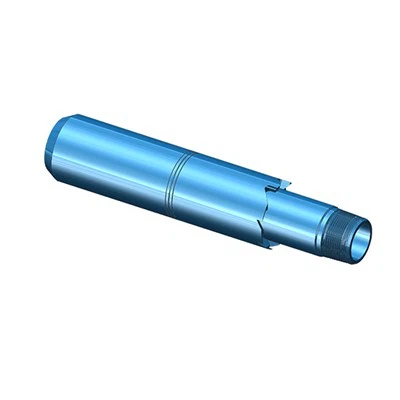
Product Introduction
The Hydraulic Toe Sleeve is a core component of multistage stimulation systems, specifically designed to initiate communication between the wellbore and reservoir in oil and gas well completions. It is run as an integral part of the shoe track during well completion and cemented in place with the liner - enabling selective stage stimulation at the toe and eliminating the need for costly and time-consuming coiled tubing (CT) or tubing conveyed perforating (TCP) operations to start toe injection. With optimized structural design and reliable performance, this tool ensures efficient and safe fracturing processes, reducing operational costs and improving well productivity for unconventional oil and gas development. Before activation, the sleeve allows operators to pressure test the casing to fracturing pressures - ensuring wellbore integrity before stimulation. When wellhead pressure reaches the preset activation pressure, the sleeve shifts hydraulically, exposing ports to the formation and establishing communication between the wellbore and the reservoir. Once activated, the sleeve remains permanently open - allowing diagnostic fracture injection test (DFIT) analysis and subsequent fracturing operations. For models with the delayed opening mechanism, a delay valve and soluble components ensure the sleeve opens at a precise time, avoiding premature activation and ensuring the smooth progress of pressure testing and fracturing operations. Constructed from high-strength steel complying with GB/T 19830 standards (with corrosion-resistant alloy options available), and featuring high-quality metal sealing rings and advanced sealing materials - ordinary rubber seals rated to 120°C, heat-resistant rubber seals rated to 200°C - the sleeve delivers working pressure of 70–140 MPa across operating temperatures from -35°C to 200°C, for reliable performance in harsh downhole conditions. The locking mechanism permanently locks the sleeve once opened, avoiding closure risks caused by pressure fluctuations during fracturing and production. With no internal or external moving parts, the sleeve ensures stable operation even with residual cement in the casing - making it suitable for both open-hole and cased-hole applications, especially cemented environments. Available in sizes matching casing/liner from 4" to 5.75" (101.6–146.1mm), with customizable activation pressure (50–130 MPa), delayed opening time (0–60 minutes), and materials for extreme downhole conditions, this Hydraulic Toe Sleeve integrates seamlessly with conventional cementing operations - requiring no special cementing plugs or landing seats. Field applications have proven that this tool saves $80,000–$120,000 per well by eliminating unnecessary CT/TCP operations and reducing downtime. Manufactured to NB/T 14020.3-2022 (Energy Industry Standard for Shale Gas Tool Equipment - Toe Sliding Sleeve for Staged Fracturing) and international oil & gas industry standards, with comprehensive OEM/ODM customization and 12-month after-sales service.
Product Features
1. Precise Pressure Control with Absolute Rupture Disc
Equipped with an absolute pressure-controlled rupture disc, the opening pressure is accurate and independent of formation pressure - avoiding premature or failed opening issues that often occur with conventional toe sleeves. The activation pressure can be customized according to customer requirements (50–130 MPa depending on size) to adapt to different well conditions, well depths, and fracture gradients. The rupture disc provides a verifiable, single-point activation threshold that cannot be affected by downhole pressure fluctuations or formation pressure variations - ensuring the sleeve opens exactly when the designed wellhead pressure is reached.
2. Reliable Delayed Opening Design (Optional)
An optional 30-minute delayed opening mechanism (customizable from 0 to 60 minutes) solves the problem of unreliable opening in shale oil wells - ensuring the integrity of the whole-well pressure test process and reducing economic losses from premature activation. Indoor tests show that the delayed opening time has a relative error of only 5.67%, meeting strict field operation requirements. The delay valve and soluble components ensure the sleeve opens at the precise time after pressure testing is complete - allowing operators to fully verify casing integrity before the sleeve opens and stimulation begins.
3. High Compatibility & Versatility - No Moving Parts
Available in various sizes to match any casing specification, covering casing/liner sizes from 4" (101.6mm) to 5.75" (146.1mm) with corresponding sleeve OD and ID specifications. Suitable for both open-hole and cased-hole applications, especially designed for cemented environments with no internal or external moving parts - ensuring stable operation even with residual cement in the casing. The all-stationary design eliminates the risk of moving parts becoming jammed by cement debris, a common failure mode in conventional toe sleeves deployed in cemented liners.
4. Superior Sealing & Permanent Locking Performance
Adopts high-quality metal sealing rings and advanced sealing materials meeting industry standards - ordinary rubber seals resist temperatures up to 120°C, while heat-resistant rubber seals withstand temperatures up to 200°C - ensuring excellent sealing performance in harsh downhole conditions across the full -35°C to 200°C operating range. Equipped with a locking mechanism that permanently locks the sleeve once opened, avoiding closure risks caused by pressure fluctuations during fracturing and production. The permanent lock ensures the sleeve remains in the open position throughout the life of the well - maintaining full bore access for production and intervention.
5. Cost-Efficient & Easy Operation - $80K–$120K Savings per Well
Integrates seamlessly with conventional cementing operations - no need for special cementing plugs or landing seats, simplifying the construction process and reducing rig time. Field applications have proven that this tool saves $80,000 to $120,000 per well by eliminating unnecessary CT or TCP operations and reducing downtime. The sleeve is run with the liner as part of the shoe track, requiring no additional trips or specialized deployment equipment - making it one of the most cost-effective toe initiation solutions for unconventional well completions.
Working Principle
The Hydraulic Toe Sleeve operates through a pressure-activated hydraulic shifting mechanism:
Deployment and Cementing
The sleeve is run as an integral part of the shoe track during well completion and is cemented in place with the liner. Before opening, the sleeve remains in the closed position - allowing operators to pressure test the casing to fracturing pressures, ensuring the integrity of the wellbore and cement sheath before stimulation begins. The no-moving-parts design ensures the sleeve remains sealed and stable during cementing, even with residual cement around the tool.
Pressure Activation
When wellhead pressure reaches the preset activation pressure (50–130 MPa depending on size and configuration), the absolute pressure-controlled rupture disc shears, and the sleeve shifts hydraulically - exposing the ports to the formation and establishing communication between the wellbore and the reservoir. The activation pressure is independent of formation pressure, ensuring accurate and repeatable opening regardless of reservoir conditions.
Delayed Opening (Optional)
For models equipped with the delayed opening mechanism, a delay valve and soluble components control the timing of sleeve opening - ensuring the sleeve opens at a precise time (0–60 minutes customizable, standard 30 minutes) after the activation pressure is reached. This allows operators to complete the full-well pressure test before the sleeve opens, avoiding premature activation and ensuring the smooth progress of pressure testing and fracturing operations. The delayed opening timing has a relative error of only 5.67% per indoor testing.
Permanent Lock and Post-Activation
Once activated, the locking mechanism permanently locks the sleeve in the open position - preventing closure caused by pressure fluctuations during fracturing and production. The permanently open sleeve allows for diagnostic fracture injection test (DFIT) analysis to characterize the reservoir, followed by subsequent fracturing operations through the exposed ports. The sleeve remains in place for the life of the well, maintaining full bore access for production and any future intervention.
Customization Service
We understand that different well conditions require tailored solutions. We offer comprehensive OEM/ODM customization services to meet your specific needs:
• Custom sleeve sizes and dimensions to match your casing specifications (beyond standard 4"–5.75" range)
• Custom activation pressure settings (within 50–130 MPa range) tailored to your well depth, fracture gradient, and pressure test requirements
• Custom delayed opening time (0–60 minutes optional) with precision timing verification
• Material customization - high-strength steel (standard), corrosion-resistant alloys (13Cr, 22Cr, Inconel), and other materials for extreme downhole conditions including CO2/H2S service
• Custom seal material - ordinary nitrile (120°C), heat-resistant rubber (200°C), or specialty elastomers for extreme temperatures or chemical environments
• Custom logo, packaging, and marking according to your brand requirements
• Sample customization and performance testing to verify activation pressure, sealing, and delay timing before bulk order
Lead time for samples: 7–10 working days. Standard production: 15–25 working days; custom production: 25–35 working days.
Quality Assurance & Certifications
Our Hydraulic Toe Sleeve is manufactured in strict accordance with NB/T 14020.3-2022 (Energy Industry Standard for Shale Gas Tool Equipment - Part 3: Toe Sliding Sleeve for Staged Fracturing) and international oil and gas industry standards including API Spec 11D1 (for downhole isolation equipment reference), API Q1 quality management, and ISO 9001:2015. The main body is made of high-strength steel complying with GB/T 19830 standards. Each product undergoes rigorous testing before leaving the factory, including:
• Pressure resistance test and activation pressure accuracy test - each sleeve hydrostatically tested to rated working pressure (70–140 MPa) with rupture disc activation pressure verified within ±5% of specified value
• Sealing performance test under high temperature and high pressure - verified at maximum rated temperature (200°C for heat-resistant seals) and pressure with zero leakage
• Material mechanical property test and corrosion resistance test - tensile strength, yield strength, hardness, and corrosion resistance verified per material specification
• Delayed opening time test (for customized models) - delay timing verified with ≤5.67% relative error per indoor testing protocol
Each shipment includes material test reports (MTR), pressure test certificates, activation pressure verification records, and operating manuals. Third-party inspection (BV, SGS, DNV) available on request. All products traceable by material batch number and serial number.
Warranty
12-month after-sales service from date of shipment, with 24/7 technical support and on-site technical support available if needed.
Application Scenarios
1. Shale Oil & Shale Gas Horizontal Well Staged Fracturing
Widely used in shale oil and shale gas horizontal well staged fracturing operations - including major plays such as Eagle Ford, Utica, Barnett, and global unconventional basins. The hydraulic toe sleeve provides reliable first-stage (toe) initiation without CT or TCP operations, enabling rapid transition from cementing to stimulation. The optional delayed opening mechanism is particularly valuable in shale oil wells where conventional toe sleeves may experience unreliable opening - ensuring the whole-well pressure test is completed before activation and reducing economic losses from premature or failed opening.
2. Cemented Well Completions Requiring Toe Injection Without CT/TCP
Ideal for cemented well completions requiring initial toe injection without coiled tubing (CT) or tubing conveyed perforating (TCP) operations. The sleeve is cemented in place with the liner and activated by wellhead pressure - eliminating the need for a separate CT/TCP trip to perforate the toe, which can cost $80,000–$120,000 per well and add significant rig time. The no-moving-parts design ensures reliable operation in cemented environments, even with residual cement in the casing.
3. Long Horizontal Section Wells Requiring Integrity Testing & Reliable Toe Opening
Designed for long horizontal section horizontal wells that require strict wellbore integrity testing and reliable toe opening. Before activation, the sleeve allows full casing pressure testing to fracturing pressures - ensuring the cement sheath and casing integrity are verified before stimulation begins. The permanent locking mechanism ensures the sleeve remains open throughout the long horizontal well's production life, and the DFIT capability allows reservoir characterization before full-scale fracturing.
4. Open-Hole & Cased-Hole Multistage Stimulation - Replacing First-Stage Perforation
Suitable for both open-hole and cased-hole multistage stimulation systems, replacing the first-stage perforation operation to improve construction efficiency. In open-hole completions, the sleeve is run with the liner and provides the initial communication point. In cased-hole completions, the cemented sleeve provides a pressure-tested barrier before activation. The sleeve's ability to allow DFIT analysis before fracturing makes it valuable for reservoir evaluation in both open-hole and cased-hole applications.
FAQ
Q: What materials are used in the Hydraulic Toe Sleeve?
A: The main body is made of high-strength steel complying with GB/T 19830 standards. Sealing parts are made of ordinary nitrile rubber (rated to 120°C) or heat-resistant rubber (rated to 200°C) with excellent oil resistance and high-temperature resistance. Corrosion-resistant alloy options (13Cr, 22Cr, Inconel) are available for CO2/H2S or extreme downhole environments. All materials meet downhole harsh environment requirements.
Q: How does the pressure activation work, and can the activation pressure be customized?
A: The sleeve uses an absolute pressure-controlled rupture disc - when wellhead pressure reaches the preset activation pressure, the disc shears and the sleeve shifts hydraulically to expose the ports. The activation pressure is independent of formation pressure, ensuring accurate and repeatable opening. Activation pressure can be customized within the 50–130 MPa range (depending on casing size) to match your well depth, fracture gradient, and pressure test requirements. Each sleeve's activation pressure is verified before shipment.
Q: What is the delayed opening mechanism and when is it needed?
A: The optional delayed opening mechanism uses a delay valve and soluble components to control the timing of sleeve opening - customizable from 0 to 60 minutes (standard 30 minutes). It is particularly valuable in shale oil wells and long horizontal wells where you need to complete the whole-well pressure test before the sleeve opens. The delay ensures the casing pressure test is fully completed before activation, avoiding premature opening. Indoor testing shows the delay timing has a relative error of only 5.67%.
Q: What is DFIT and can this sleeve support it?
A: DFIT stands for Diagnostic Fracture Injection Test - a reservoir characterization technique where a small volume of fluid is injected at low rate to measure reservoir pressure, permeability, and fracture gradient before full-scale fracturing. Once the Hydraulic Toe Sleeve is activated and permanently open, it provides the communication point needed to perform DFIT analysis through the exposed ports, followed by subsequent fracturing operations. This eliminates the need for a separate DFIT deployment.
Q: How does this compare to CT or TCP toe initiation?
A: Conventional toe initiation requires a separate coiled tubing (CT) or tubing conveyed perforating (TCP) trip to perforate the toe after cementing - costing $80,000–$120,000 per well and adding 1–3 days of rig time. The Hydraulic Toe Sleeve is run with the liner and activated by wellhead pressure, eliminating the CT/TCP trip entirely. It also allows casing pressure testing before opening, which CT/TCP perforating does not provide.
Q: Can you provide samples before bulk order?
A: Yes, we can provide customized samples. The sample lead time is 7–10 working days, and we can arrange performance testing - including activation pressure verification, sealing test, and delayed opening timing - according to your requirements before bulk order.
Q: What is the MOQ and delivery time?
A: The MOQ is 1 piece for customized orders, and 10 pieces for standard orders. Delivery time is 15–25 working days for standard products and 25–35 working days for customized products. We ship from Shanghai or Ningbo port. Payment terms include T/T, L/C at sight, and Western Union.
Q: Do you provide after-sales service and technical support?
A: Yes, we provide 12-month after-sales service from date of shipment. Our technical team is available 24/7 to solve any operational problems and provide on-site technical support if needed. Our engineers will communicate with you in detail to confirm your casing size, operating pressure, temperature, applicable depth, and other parameters - providing tailored solutions and performance verification reports before delivery.
Hot Tags: Hydraulic Toe Sleeve | Multistage Stimulation | Pressure-Activated Rupture Disc | 30-Min Delayed Opening | DFIT | 70-140 MPa | -35~200°C | 4"-5.75" | Eliminate CT/TCP, China Hydraulic Toe Sleeve | Multistage Stimulation | Pressure-Activated Rupture Disc | 30-Min Delayed Opening | DFIT | 70-140 MPa | -35~200°C | 4"-5.75" | Eliminate CT/TCP manufacturers, suppliers, factory, Hydraulic Anchor, Safety Joint, Pump Out Plug, Hydraulic Setting Tools, Tubing Anchor Catcher, On Off Tool
| Item | Specification | Remarks |
|---|---|---|
| Product Type | Hydraulic Toe Sleeve | Pressure-activated downhole stimulation tool |
| Casing/Liner Size | 4" – 5.75" (101.6 – 146.1mm) | 5 standard sizes; custom sizes available |
| Sleeve OD | 4.45" – 6.75" (113 – 171.5mm) | Size-dependent, see dimension table |
| Sleeve ID | 3.35" – 4.875" (85.1 – 123.8mm) | Size-dependent, see dimension table |
| Working Pressure | 70 – 140 MPa (10,150 – 20,300 PSI) | All sizes |
| Activation Pressure | 50 – 130 MPa (7,250 – 18,850 PSI) | Size-dependent; customizable |
| Activation Method | Absolute pressure-controlled rupture disc, hydraulic shift | Independent of formation pressure |
| Operating Temperature | -35°C to 200°C (-31°F to 392°F) | Standard nitrile 120°C; heat-resistant 200°C |
| Applicable Depth | 2,500 – 4,000 m (8,200 – 13,120 ft) | Depending on size and pressure rating |
| Delayed Opening | Optional, 0 – 60 min (standard 30 min) | Timing error ≤5.67%; delay valve + soluble components |
| Sealing Material | Metal sealing rings + nitrile rubber (120°C) or heat-resistant rubber (200°C) | Custom elastomers available |
| Body Material | High-strength steel (GB/T 19830); corrosion-resistant alloy options (13Cr/22Cr/Inconel) | Custom for CO2/H2S service |
| Locking Mechanism | Permanent lock after activation | Prevents closure from pressure fluctuations |
| Moving Parts | None (no internal/external moving parts) | Stable in cemented/residual-cement environments |
| DFIT Capability | Yes - after activation, supports diagnostic fracture injection test | Permanent open bore access |
| Deployment | Run with liner as part of shoe track, cemented in place | No special cementing plugs or landing seats |
| Application | Open-hole and cased-hole; shale oil/gas, horizontal well staged fracturing, toe initiation | Replaces CT/TCP first-stage perforation |
| Standard / Certification | NB/T 14020.3-2022, GB/T 19830, API Spec 11D1 (ref.), API Q1, ISO 9001:2015 | Third-party BV/SGS/DNV on request |
| MOQ | 1 piece (custom); 10 pieces (standard) | - |
| Delivery Time | 15 – 25 working days (standard); 25 – 35 working days (custom) | Samples: 7–10 working days |
| Packaging | Individual plastic wrap + export wooden crate | - |
| Warranty | 12 months from shipment; 24/7 technical support | On-site support available |
| Casing/Liner Size (in/mm) | Sleeve OD (in/mm) | Sleeve ID (in/mm) | Working Pressure (MPa) | Activation Pressure (MPa) | Temp (°C) | Depth (m) |
|---|---|---|---|---|---|---|
| 4 / 101.6 | 4.45 / 113.0 | 3.35 / 85.1 | 70–140 | 50–110 | -35~200 | 2500–4000 |
| 4.5 / 114.3 | 5.25 / 133.4 | 3.85 / 97.8 | 70–140 | 50–110 | -35~200 | 2500–4000 |
| 5 / 127.0 | 5.625 / 142.9 | 4.125 / 104.8 | 70–140 | 50–120 | -35~200 | 2500–4000 |
| 5.5 / 139.7 | 6.5 / 165.1 | 4.75 / 120.7 | 70–140 | 50–130 | -35~200 | 2500–4000 |
| 5.75 / 146.1 | 6.75 / 171.5 | 4.875 / 123.8 | 70–140 | 50–130 | -35~200 | 2500–4000 |