

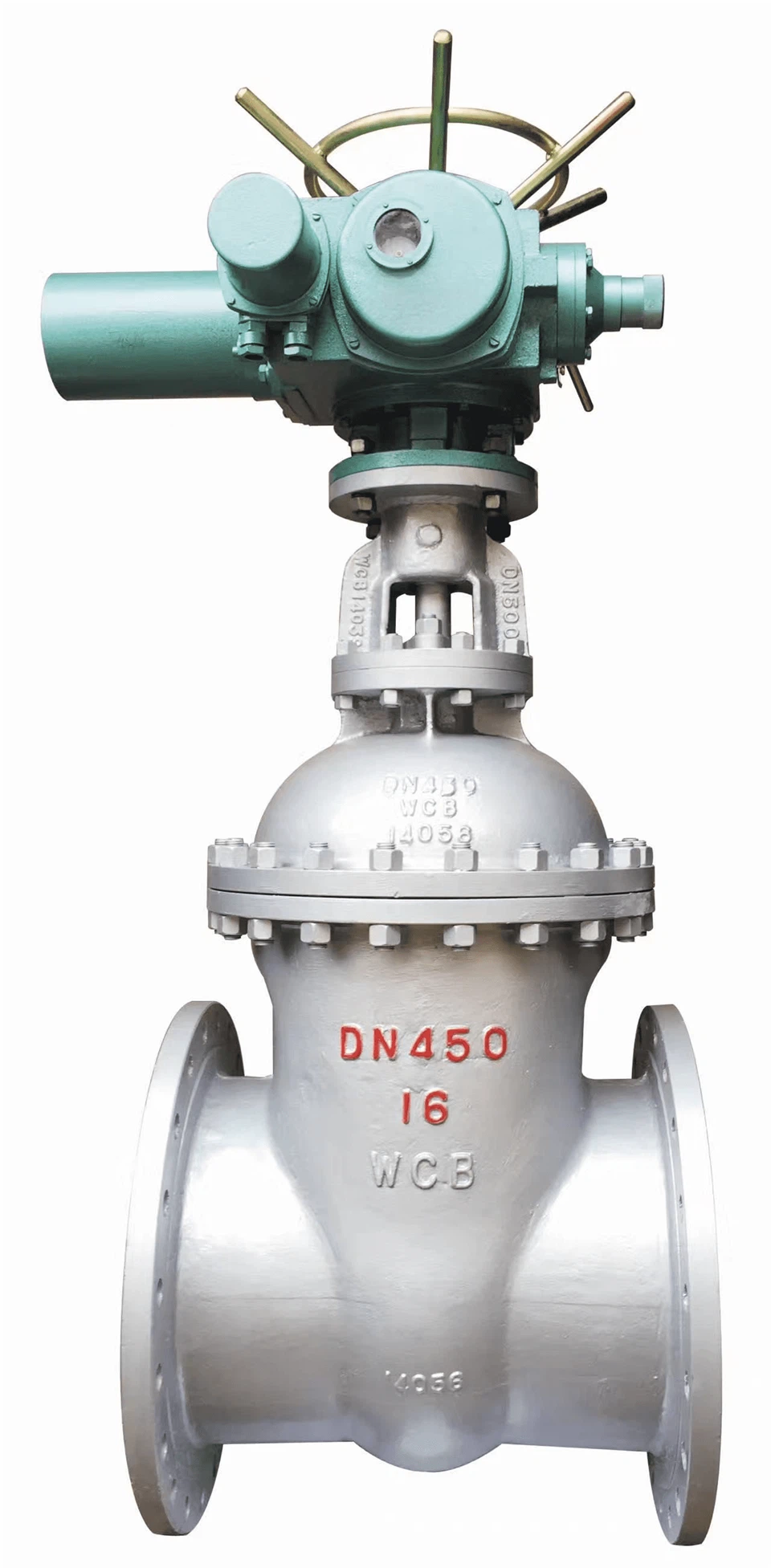
Product Introduction
The Electric Flange Gate Valve is an industrial on-off isolation valve controlled by an intelligent electric actuator, flanged RF/RTJ per ASME B16.5. Actuator drives OS&Y wedge gate (elastic/double-gate) to lift/lower, with remote/local/manual operation, PLC/DCS via 4~20mA, torque control, ±1% feedback, IP66/IP68, optional Ex d explosion-proof, and fail-safe. Bidirectional Stellite 6 metal or PTFE/RPTFE/EPDM/Viton soft seal, zero leakage, ISO 15848-1, API 607 fire-safe, anti-static. Body WCB/CF8/CF8M/WC6/WC9/Hastelloy/2205/QT450-10. DN50–DN1200, PN10–PN420 (Class 150–2500), -196~600°C. Per API 600/6D, ASME B16.34, ISO 5752, tested API 598/ISO 5208. For oil & gas, chemical, power, municipal, new energy.
Product Features
1. Superior Sealing Performance: Adopts bidirectional metal-to-metal sealing or PTFE soft sealing design, with metal seal surface surfacing Stellite 6 hard alloy for enhanced wear and corrosion resistance, and soft seal achieving zero leakage (compliant with ISO 15848-1 low-emission certification). The pressure self-tightening seal or gasket sealing structure ensures safe and reliable operation, effectively preventing medium leakage and ensuring pipeline safety in both flow directions.
2. Intelligent Electric Actuation: Equipped with high-performance electric actuator supporting remote control, local operation, and manual/electric switching, integrable with PLC/DCS systems through 4~20mA current input/output for intelligent control. Built-in torque control and position feedback functions display gate position in real time with ±1% accuracy, automatically stopping and alarming when the valve is stuck to avoid equipment damage. The actuator has IP66/IP68 protection, suitable for outdoor, humid, and harsh environments.
3. Robust & Durable Construction: Valve body available in WCB carbon steel, CF8/CF8M stainless steel, WC6/WC9 chromium-molybdenum steel, Hastelloy C-276, 2205 duplex stainless, and QT450-10 ductile iron, selected per medium and working conditions for excellent corrosion, high-temperature, and pressure resistance. The wedge-type elastic gate or double-gate structure with universal joint automatically adjusts gate-to-seat fit, facilitating maintenance and ensuring sealing reliability under thermal cycling.
4. High Compatibility & Easy Installation: Adopts standard flange connection compliant with ASME B16.5 and ISO 7005, supporting Raised Face (RF) and Ring Type Joint (RTJ) sealing surfaces to meet installation needs of different pipeline systems worldwide. The compact design, small volume, and light weight make installation and integration easy, saving space and construction costs, with full-bore or reduced-bore options available.
5. Safety & Reliability: Equipped with built-in anti-static device to prevent static accumulation and reduce fire/explosion risk, suitable for flammable and explosive media. Complies with API 607 fire-safe design, maintaining sealing performance in case of fire to prevent medium leakage. Fail-safe function supports spring return (fails to open or close) or position retention on power failure to avoid safety accidents, with emergency manual override via handwheel.
6. Low Flow Resistance & Energy Saving: When fully open, the gate is completely separated from the flow channel, with a flow resistance coefficient (Cv) 1.5~2 times that of the same-diameter butterfly valve and minimal pressure loss, effectively reducing pipeline system energy consumption. The full-bore design supports pigging operations in oil and gas pipelines, while the reduced-bore design reduces valve weight and cost.
Working Principle
The Electric Flange Gate Valve operates on the wedge gate principle for on-off isolation, powered by an intelligent electric actuator. Actuator drives OS&Y stem via gearbox to lift/lower wedge gate: open, low-resistance flow; closed, tight seal. Elastic/double-gate auto-aligns, avoids thermal binding. Actuator: remote PLC/DCS 4~20mA, local, manual override; torque switch, ±1% position feedback. IP66/IP68, Ex d option, fail-safe. Bidirectional Stellite 6/PTFE seats, zero leakage, ISO 15848-1, API 607, anti-static. For open/closed isolation only - not throttling.
Application Scenarios
Oil & Gas Industry: Applied in oil and gas field exploration, gathering and transportation, refining, and long-distance pipeline systems, suitable for crude oil, natural gas, and other media transportation. Withstands high pressure above 10 MPa, high temperature above 350°C, and resists H₂S corrosion, with sealing level up to API 6D SS (bubble-level leakage). Also applicable to underwater oil production trees and seabed pipeline connections in deep-sea oil and gas exploitation, withstanding water pressure at 1500 meters depth.
Chemical & Coal Chemical Industry: Used in coal gasification furnace feeding systems, methanol synthesis towers, electrolyte transportation pipelines of lithium battery factories, and semiconductor etching gas pipelines. Resists corrosion of strong acids, alkalis, and chemical media (such as HF), and adapts to high-pressure and high-temperature working conditions up to 25 MPa and 650°C, effectively solving media erosion and pipeline blockage problems.
Power Industry: Suitable for thermal power plants, nuclear power plants, and solar thermal power plants. In thermal power plants, used in superheated steam pipelines withstanding 540°C; in nuclear power plants (such as Hualong One), used in reactor coolant systems resisting radiation and ensuring safe operation. In solar thermal power storage systems, applied to molten salt storage tanks and heat transfer oil circulation pipelines, withstanding 400°C and molten salt corrosion.
Municipal & Environmental Engineering: Widely used in urban heating pipe networks, water supply and drainage projects, and sewage treatment plants. Resists sediment wear and H₂S corrosion, with health level complying with GB/T 17219, effectively improving water treatment and heat supply efficiency and reducing maintenance costs. Electric actuation enables remote monitoring and automated operation of large municipal networks.
New Energy & High-End Manufacturing: Applied in hydrogen energy industry (vehicle-mounted hydrogen supply systems, hydrogen refueling stations), semiconductor wafer manufacturing, and new energy vehicle charging pile supporting systems. Meets requirements of high pressure (up to 70 MPa), high cleanliness (ISO 14644-1 Class 5), and wide temperature range, realizing localized substitution of imported products and reducing costs by 40%.
Quality Assurance
Every Electric Flange Gate Valve is manufactured and tested per API 600, API 6D, ASME B16.34, ISO 5752, ISO 9001. Raw materials MTR-verified with chemical/mechanical tests. Castings 100% RT/UT inspected; Stellite 6 hardfacing hardness/PT verified. Flanges 100% verified per ASME B16.5. OS&Y engagement and backseat verified. Actuator tested for function, torque, ±1% position, IP66/IP68, Ex d option. Valves get dimensional, shell 1.5×, seat 1.1× per API 598, gas seal test. ISO 15848-1 and API 607 verified. Anti-static tested. Units ship with MTR, test certs, 18-month warranty, BV/SGS, CE/PED on request.
FAQ
Q1: What are the control modes of the electric actuator, and can it integrate with my PLC/DCS system?
A: Our electric flange gate valve actuator supports three operation modes that can be selected or combined:
Remote Control: The actuator accepts a 4~20mA analog control signal (or optional 0~10V, Profibus, Modbus RTU/TCP, HART, Foundation Fieldbus) from a PLC, DCS, or SCADA system to open/close or modulate the valve. It also outputs a 4~20mA position feedback signal (±1% accuracy) so the control room sees the exact valve position in real time. Limit switches (open/close) and torque switches are available as discrete outputs for status and fault indication.
Local Control: A local control panel on the actuator housing provides OPEN/CLOSE/STOP pushbuttons (or selector switch) for on-site operation, with a position indicator window showing valve opening percentage. This is used during commissioning, maintenance, or when remote control is unavailable.
Manual Override: An integral handwheel (or crank) provides emergency manual operation in case of power failure or actuator malfunction. The manual/electric selector declutches the motor drive so the handwheel can directly operate the valve stem. For large sizes, a gear operator is provided to reduce operating effort. Integration with PLC/DCS is straightforward: wire the 4~20mA output from your controller to the actuator's control input, and wire the actuator's 4~20mA position feedback to your analog input card. Power supply is typically 380V 3-phase 50/60Hz (standard), with 220V single-phase, 24V DC, or 110V DC available on request. We provide full wiring diagrams, I/O lists, and can supply actuators pre-configured to your control system specifications. For hazardous areas, choose the Ex d IIB T4 or Ex d IIC T6 explosion-proof variant with certified cable glands.
Q2: What is the difference between fail-safe spring return and position retention (fail-last), and which should I choose?
A: These are the two common fail-safe behaviors for electric actuators on power loss:
Fail-Safe Spring Return (Fail-Open or Fail-Close): The actuator contains a powerful spring that is charged during normal electric operation. On power loss (or signal loss), the spring automatically drives the valve to a pre-determined safe position - either fully open (fail-open, FO) or fully closed (fail-close, FC). This ensures the valve goes to a known safe state without external power. Spring return is required for safety-critical applications where the valve must isolate or vent on power failure, such as emergency shutdown (ESD) systems, fuel gas lines, toxic media, and fire protection. Note: spring return adds size, weight, and cost, and the spring torque must be matched to the valve's required operating torque.
Position Retention (Fail-Last / Locked-in-Place): On power loss, the actuator's motor and gearbox hold the valve in its current position (the worm gear is self-locking, so the valve does not drift). The valve stays wherever it was when power was lost. This is the standard (default) configuration for most electric actuators and is suitable for non-safety-critical applications where holding the last position is acceptable, such as general process isolation, water distribution, and HVAC. It is simpler, lighter, and less expensive than spring return. Selection guide: Choose fail-close (FC) for safety isolation where the valve must shut off flow on power loss (fuel, toxic, hazardous media, ESD). Choose fail-open (FO) for venting, bypass, or fire protection where the valve must open on power loss (e.g., relief, deluge). Choose position retention (fail-last) for general service where the process can tolerate the valve holding its position and an operator can respond. Always consult your plant's safety instrumented system (SIS) and HAZOP study to determine the required fail state for each valve.
Q3: What protection level and explosion-proof grade is available for the electric actuator?
A: Our electric actuators offer the following environmental and hazardous-area protection:
Standard Protection: IP66 (dust-tight, protected against powerful water jets from any direction) as standard. Suitable for outdoor installation, wash-down areas, and dusty industrial environments.
Optional Higher Protection: IP68 (dust-tight, continuous submersion in water under specified pressure and time - typically up to 10 meters for 72 hours) for submersible, buried, or flood-prone installations.
Explosion-Proof (Flameproof) Grade:
Ex d IIB T4: Suitable for Zone 1/2 hazardous areas with Group IIB gases (e.g., propane, ethylene, ethanol), maximum surface temperature 135°C (T4). The most common explosion-proof rating for oil & gas, chemical, and petrochemical facilities.
Ex d IIC T6: Suitable for Zone 1/2 hazardous areas with Group IIC gases (e.g., hydrogen, acetylene, carbon disulfide - the most hazardous group), maximum surface temperature 85°C (T6). Required for hydrogen service, acetylene, and applications with very low ignition temperature gases.
Certifications: ATEX (EU), IECEx (international), and CCCEx (China) available on request, with certified cable glands and breathing/draining plugs.
Other Options: Corrosion-resistant epoxy coating for offshore/marine service; low-temperature models for -40°C ambient; tropicalized (TH) treatment for high-humidity tropical climates; heater and thermostat inside the actuator to prevent condensation in cold/humid environments. Please specify your ambient conditions, hazardous area classification (Zone, Gas Group, Temperature Class), and required certifications when ordering so we can configure the correct actuator.
Q4: What body materials and sealing options are available, and how do I choose?
A: Our electric flange gate valves offer a comprehensive range of materials and seals:
Body/Bonnet Materials:
WCB (ASTM A216 Grade WCB): Carbon steel cast. Standard for general water, oil, gas, steam service up to 425°C. Most economical. Not for corrosive service.
CF8 / CF8M (304 / 316 stainless cast): Austenitic stainless steel for corrosive chemical, seawater, food, pharmaceutical service. CF8M (316) with molybdenum for chloride resistance.
WC6 / WC9 (1.25Cr-0.5Mo / 2.25Cr-1Mo cast): Chromium-molybdenum steel for high-temperature steam and power plant service up to 593°C.
Hastelloy C-276: Nickel-molybdenum-chromium superalloy for extremely corrosive media (strong acids, chlorides, HF, oxidizing acids). High cost, for severe service.
2205 Duplex Stainless: Dual-phase (ferritic-austenitic) stainless with high strength and excellent chloride pitting/crevice resistance, for seawater, desalination, and oil & gas.
QT450-10: Ductile iron for water and general utility service, economical with good strength.
Gate & Seat Sealing:
Metal-to-Metal (Stellite 6): Cobalt-chromium hard alloy surfacing on gate and seat. High temperature, high pressure, abrasive media, fire-safe. Some allowable leakage per API 598 (metal seal).
PTFE / RPTFE (Reinforced PTFE): Soft seat for chemical service, zero leakage, good chemical resistance, limited to ~200°C.
EPDM: Rubber soft seat for water, steam, hot water, zero leakage, limited to ~150°C.
Viton (FKM): Fluorocarbon rubber for oil, fuel, hydrocarbon, high-temperature chemical service, zero leakage, up to ~200°C.
NBR (Nitrile): For oil and gas service, limited to ~100°C. Selection: Match body material to medium corrosion and temperature; choose metal seat for high temp/high pressure/fire-safe, soft seat (PTFE/EPDM/Viton) for zero-leakage chemical/water/oil service. Always verify material and seal compatibility with your specific medium, concentration, temperature, and pressure.
Q5: What maintenance does the electric actuator and valve require?
A: Electric flange gate valves are designed for long service life (10+ years) with minimal maintenance, but proper care ensures reliable performance:
Actuator Maintenance:
Periodic exercising: Operate the valve through a full open-close cycle at least once every 6–12 months (or per plant RBI program) to prevent stem seizure, verify actuator function, and check torque switch and limit switch operation. For critical service, schedule during planned outages.
Visual inspection: Check actuator housing for damage, corrosion, loose fasteners; check cable glands and wiring for integrity; verify position indicator matches actual valve position; check for oil leaks from the gearbox (if oil-lubricated).
Gearbox lubrication: The actuator gearbox is typically grease-lubricated and sealed for life, but for heavy-cycling or high-temperature service, re-grease per the actuator manufacturer's manual (typically every 2–5 years).
Heater/thermostat: If equipped, verify the anti-condensation heater is functioning (especially in cold/humid environments).
Calibration: Periodically verify position feedback (4~20mA) accuracy against actual valve position; recalibrate if drift exceeds ±1%. Verify torque switch settings.
Valve Body Maintenance:
Packing: Monitor the packing gland for external leakage; re-torque if needed (follow manufacturer's torque procedure). If the valve has a backseat feature, packing can often be replaced online with the valve fully open.
Seat/gate inspection: During major overhauls (every 5–10 years or per RBI), inspect Stellite/PTFE/EPDM/Viton seat and gate surfaces for wear, scoring, or erosion; replace soft seats if damaged.
Flange gaskets: Inspect during pipeline outages; replace if leakage or deterioration is found.
Storage: Spare valves/actuators should be stored indoors in a dry, clean environment with flange protectors; exercise periodically; do not store with the gate fully seated for long periods. Always follow the plant's mechanical integrity program (API 570) and the actuator manufacturer's O&M manual for specific intervals and procedures.
Hot Tags: Electric Flange Gate Valve | API 600/6D | IP66/IP68, China Electric Flange Gate Valve | API 600/6D | IP66/IP68 manufacturers, suppliers, factory, 2 in brass gate valve, water meter gate valve, ball valve gate valve, pvc slide gate, 1 1 2 inch gate valve, hdpe gate valve
| Item | Specification |
|---|---|
| Product Name | Electric Flange Gate Valve |
| Valve Type | OS&Y Wedge Gate Valve (elastic wedge or double-gate universal joint), bolted bonnet, on-off isolation service |
| Design & Manufacturing Standard | API 600, API 6D, ASME B16.34, ISO 5752 |
| Body / Bonnet Material | WCB, CF8, CF8M, WC6, WC9, Hastelloy C-276, 2205 Duplex Stainless, QT450-10 Ductile Iron |
| Nominal Diameter | DN50–DN1200 (NPS 2"–48") |
| Pressure Rating | PN10–PN420 / ANSI Class 150–Class 2500 |
| Operating Temperature | -196°C ~ +600°C (depends on material; WCB: -29°C~425°C) |
| End Connection | Flanged (RF / RTJ), compliant with ASME B16.5, ISO 7005 |
| Gate & Seat Material | Gate: WCB + Stellite 6, CF8, CF8M; Seat: Stellite 6 (metal), PTFE, RPTFE, EPDM, Viton, NBR (soft) |
| Valve Stem Material | 304, 316, F304 Stainless Steel (polished) |
| Packing / Gasket Material | Graphite, PTFE (ISO 15848-1 low-emission); spiral-wound or metal gaskets |
| Operation Mode | Electric (Remote Control + Local Control + Emergency Manual Override via Handwheel) |
| Actuator Features | PLC/DCS 4~20mA, torque control, ±1% position feedback, auto-stop/alarm on jam |
| Actuator Protection | IP66 standard; IP68 optional; Ex d IIB T4 / Ex d IIC T6 explosion-proof optional (ATEX/IECEx/CCCEx) |
| Fail-Safe Mode | Position retention (standard); Spring return fail-open / fail-close (optional) |
| Special Features | Anti-static device, API 607 fire-safe design, backseat for online packing maintenance, full-bore / reduced-bore |
| Testing Standard | API 598, ISO 5208 (Shell Test 1.5×Pr, Seat Test 1.1×Pr, gas/bubble seal test) |
| Leakage Standard | Zero Leakage (soft seat) / API 598 allowable (metal seat); ISO 15848-1 low emission |


