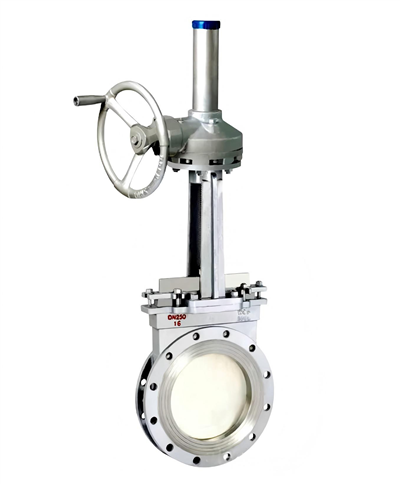
Product Introduction
Pneumatic Ceramic Single Gate Valve - specialized industrial on-off valve for abrasive and corrosive media in harsh working conditions. Single gate with toughened ceramic (Al₂O₃/ZrO₂) seal, Mohs 9 / HRC≥85, paired with pneumatic actuator (double-acting/spring-return) for fast automated operation. Ceramic delivers extreme hardness, corrosion resistance (pH 1–14 inert), and 5–10× wear life vs. metal. Precision seal Ra0.05μm, tight hard seal; single seat, anti-ash/slag/jam. Compact, any-angle install, anti-blocking purge, cleaning holes; 500k-cycle life. Rod isolated; spring-return fail-safe. ISO 9001, CE, SGS. For power, mining, metallurgy, petrochemical, paper, cement - reliable critical pipeline control.
Product Features
1. Exceptional Wear Resistance: The gate and valve seat are made of high-grade toughened structural ceramics (alumina Al₂O₃ or zirconia ZrO₂), with a Mohs hardness of up to 9 (second only to diamond) and hardness ≥HRC 85. This ensures superior resistance to erosion and friction from abrasive media such as fly ash, ore particles, and cement powder, extending service life to 5–10 times that of traditional stainless steel valves - significantly reducing replacement frequency and downtime in abrasive service.
2. Strong Corrosion Resistance: Ceramic materials are inert to almost all organic and inorganic chemicals, maintaining stable performance in media with a pH value of 1–14, including sulfuric acid, hydrochloric acid, and corrosive slurries. This eliminates corrosion-related damage and ensures no medium pollution, making it suitable for harsh chemical working conditions where metal valves would corrode and leak rapidly.
3. Reliable Sealing Performance: The ceramic sealing surfaces are precision ground and polished to a roughness of Ra0.05μm, with a low friction coefficient (μ=0.15), achieving tight hard sealing with minimal leakage. The single valve seat and one-way pressure-bearing sealing design effectively prevent ash accumulation, slag buildup, and valve jamming, ensuring stable operation even in dusty or slurry-filled environments where conventional valves seize.
4. Efficient Pneumatic Actuation: Equipped with a high-quality pneumatic actuator (available in double-acting or spring-return types), the valve achieves fast opening and closing responses, enabling automated control and easy integration into industrial automation systems. The spring-return type ensures automatic reset to a safe position in case of air supply failure, enhancing operational safety. The actuator's piston rod does not directly contact the medium, further extending its service life.
5. Compact Structure & Flexible Installation: The valve features a compact design that saves installation space and allows for arbitrary angle installation. The full-through feed port with an automatic compressed air anti-blocking device minimizes ash accumulation and jamming, while the detachable blind plate at the bottom prevents slag deposition from affecting valve closure. Valves on both sides are equipped with cleaning holes for easy maintenance without full disassembly.
6. Cost-Effective & Low Maintenance: Despite a slightly higher initial investment than metal valves, the extended service life (up to 500,000 operations, equivalent to ~22.8 years of normal use) and reduced maintenance frequency significantly lower lifecycle costs. The valve's simple structure and wear-resistant ceramic components minimize downtime and maintenance workloads, improving overall production efficiency and reducing total cost of ownership.
Working Principle
The Pneumatic Ceramic Single Gate Valve: pneumatic actuator → piston rod → single ceramic gate → single ceramic seat → full-bore body. Air/spring drives piston rod to move ceramic gate. Closing: ceramic face engages seat, tight hard seal; one-way pressure assists. Opening: gate retracts, full-bore flow, no clogging. Ceramic (Mohs 9) resists erosion, 5–10× metal life. Single seat prevents ash/slag/jam. Anti-blocking purge, bottom blind plate prevent clogging. Pneumatic fast automated; spring-return fail-safe. Rod isolated; side cleaning holes. On-off only, not throttling. Compact, any-angle.
Application Scenarios
Thermal Power Plants: Used in dry ash systems, lime slurry pipelines, fly ash conveying, and silo pump feeding/discharging valves. The ceramic gate/seat resists erosion from fly ash and lime slurry particles that rapidly destroy metal valves; the single-seat one-way design and anti-blocking air purge prevent ash accumulation and jamming in pneumatic conveying systems. The full-bore design allows ash-laden flow to pass without clogging, and the compact structure fits easily in power plant ash handling layouts.
Mining & Metallurgy: Used in conveying pipelines for copper, zinc, and nickel suspensions, ore particles, coal powder, and mineral slurry on-off control in mining; and ore, coal, coke, and carbon powder conveying / pneumatic conveying systems in steel works. The extreme hardness (Mohs 9) of the ceramic sealing surfaces withstands the abrasive wear of ore particles and coal/coke powder - 5–10× the life of metal valves. The anti-blocking purge and detachable bottom blind plate handle slag and particle buildup common in mining/metallurgy service.
Petrochemical & Chemical Industry: Ideal for catalyst slurries, corrosive chemical media, and acid-base solution pipelines - ensuring corrosion-resistant and wear-resistant operation. The ceramic material is inert to pH 1–14 chemicals (sulfuric acid, hydrochloric acid, corrosive slurries), eliminating corrosion damage and medium pollution. The precision-ground ceramic seal (Ra0.05μm) provides tight hard sealing for chemical isolation, and the pneumatic actuator enables automated DCS control in petrochemical plants.
Polysilicon, Alumina & Paper: Used in silicon powder and aluminium oxide powder conveying and control in the polysilicon/alumina industry; and kaolin, wood particles, and pulp pipeline on-off control in paper & pulp. The ceramic sealing resists abrasion from fine powders and pulp fibers, and the inert ceramic ensures no contamination of high-purity polysilicon/alumina products. The full-bore anti-blocking design prevents powder bridging and pulp fiber clogging.
Cement & Other Industries: Used in cement, glass, and fiber pneumatic conveying; fertilizer industry ammonium nitrate slurry control; and environmental protection equipment fluid control. The ceramic valve's wear resistance handles cement powder and abrasive fertilizers, while the corrosion resistance handles chemical environmental treatment media. Compact any-angle installation and low maintenance make it suitable for diverse industrial conveying systems where metal valves fail prematurely.
Quality Assurance
Every Pneumatic Ceramic Single Gate Valve is manufactured and tested per ISO 9001, CE, SGS. Raw materials verified: ceramic (Al₂O₃/ZrO₂) hardness/composition; metal body MTR + tests. Ceramic seals inspected for flatness, roughness, cracks. Metal castings RT/UT; machining dimensions verified. Actuator: pressure, spring, stroke tested. Assembly: gate-seat alignment, air tightness, 5-cycle stroke, sealing test (air/water). Anti-blocking purge, blind plate, cleaning holes verified. Shell and seat pressure tested before shipment. Material batch traceable. Ship with cert, test report, O&M manual. 18-month warranty. CE, SGS, BV/SGS on request.
FAQ
Q1: What is a pneumatic ceramic single gate valve, and when should I use it?
A: A pneumatic ceramic single gate valve is an automated on-off valve that uses a single flat gate with toughened structural ceramic (alumina Al₂O₃ or zirconia ZrO₂) sealing surfaces, driven by a pneumatic actuator (double-acting or spring-return). It is designed specifically for abrasive and/or corrosive media - fly ash, ore slurry, cement powder, catalyst slurry, corrosive chemicals - where traditional metal-seated valves fail rapidly due to erosion or corrosion. Use it when: (a) your medium is abrasive (particles, powder, slurry) and metal valves wear out quickly; (b) your medium is corrosive (pH 1–14, acids, alkalis) and metal valves corrode; (c) you need automated on-off isolation with fast pneumatic response; (d) you want 5–10× longer service life to reduce downtime and replacement cost. Do NOT use it for throttling/flow regulation (it is on-off only) or for clean, non-abrasive service where a cheaper metal valve would suffice. The ceramic's Mohs 9 hardness and chemical inertness make it the preferred choice for harsh abrasive/corrosive on-off service.
Q2: What are the advantages of ceramic sealing vs. metal sealing?
A: Ceramic sealing (toughened alumina Al₂O₃ or zirconia ZrO₂) offers three key advantages over metal sealing (stainless steel, Stellite, etc.): (1) Far superior wear resistance - ceramic Mohs hardness 9 (≥HRC 85) vs. Stellite ~HRC 40–45 and stainless ~HRC 20, giving 5–10× service life in abrasive media (fly ash, ore, cement powder); (2) Superior corrosion resistance - ceramic is inert to virtually all organic/inorganic chemicals across pH 1–14 (sulfuric acid, hydrochloric acid, corrosive slurries), while most metals corrode in strong acids/alkalis; (3) Excellent sealing performance - ceramic can be precision-ground to Ra0.05μm with low friction coefficient (μ=0.15), achieving tight hard sealing with minimal leakage, and ceramic does not gall or seize like metal. Trade-offs: ceramic is brittle (subject to thermal shock and mechanical impact - avoid water hammer and rapid temperature changes), has higher initial cost, and is not suitable for throttling (high-velocity partial flow can chip ceramic edges). For abrasive/corrosive on-off service, ceramic is far more cost-effective over the lifecycle despite higher upfront cost.
Q3: What is the difference between double-acting and spring-return pneumatic actuators?
A: Two actuator types are available: Double-acting: compressed air drives both the opening and closing strokes via two air ports (one for open, one for close). It provides positive force in both directions, faster cycling, and higher seating force, but requires continuous air pressure to hold position - if air supply fails, the valve stays in its last position (fail-last). Use when air supply is reliable and fail-last is acceptable, or when higher seating force is needed. Spring-return (single-acting): compressed air drives one stroke (typically opening), and an internal spring drives the return stroke (closing). If air supply fails, the spring automatically returns the valve to the closed (safe) position - this is fail-safe (fail-closed). It uses less air (only one direction powered) and provides automatic safety shutdown on air loss, but has lower seating force (spring-limited) and slower closing (spring speed). Choose spring-return when safety is critical (e.g., hazardous media, ESD requirements, unreliable air supply) and you want the valve to fail closed on air loss. Choose double-acting when you need positive force in both directions, faster cycling, or fail-last behavior. Both types have the piston rod isolated from the medium to extend actuator life.
Q4: How does the anti-blocking design work for ash/slurry service?
A: Ash, powder, and slurry media tend to accumulate in valve cavities and cause jamming - this valve has several anti-blocking features: (1) Full-through feed port with automatic compressed air anti-blocking device: a small air purge line injects compressed air into the gate cavity/guide area during operation, blowing accumulated ash/slag out and preventing it from packing into the gate guides and causing jamming. This is especially important for pneumatic conveying systems where fine powder can infiltrate every crevice. (2) Detachable bottom blind plate: the bottom of the valve body has a removable blind plate that can be unbolted to remove accumulated slag/debris without removing the entire valve from the line - simplifying cleaning and preventing slag deposition from interfering with gate closure. (3) Single valve seat, one-way pressure-bearing design: unlike double-seat valves that trap media between two seats, the single-seat design has only one sealing interface, reducing the cavity area where ash/slag can accumulate and eliminating the "between-seats" dead zone that causes jamming. (4) Side cleaning holes: both sides of the valve have cleaning/inspection holes that allow flushing or visual inspection without full disassembly. Together these features ensure reliable operation in dusty/slurry environments where conventional valves seize frequently.
Q5: What maintenance is required, and what is the expected service life?
A: Expected service life: up to 500,000 open-close cycles (equivalent to ~22.8 years at normal use, ~60 cycles/day) - 5–10× that of stainless steel valves in abrasive service. Actual life depends on medium abrasiveness, particle size, operating frequency, and pressure. Maintenance: (1) Periodic inspection: check for external leakage around the seat and actuator, verify smooth gate operation, inspect ceramic sealing surfaces for chipping/cracking during scheduled outages (ceramic is brittle - watch for edge chipping from water hammer or foreign objects). (2) Pneumatic actuator: inspect air supply lines/filters, check cylinder for air leakage, lubricate per manufacturer schedule, verify spring force (spring-return type) and stroke/speed. (3) Anti-blocking system: ensure the compressed air purge line is clean and functioning; periodically flush through side cleaning holes; remove and clean the bottom blind plate if slag accumulates. (4) Seal replacement: when ceramic seat/gate shows excessive wear or chipping, replace inline (the gate and seat are designed for replaceability - isolate and drain the line, remove the actuator and bonnet, replace ceramic components). (5) Avoid water hammer and rapid thermal cycling - ceramic is brittle and can crack from sudden pressure/temperature shocks; install slowly-closing actuation or surge protection where water hammer is possible. With proper maintenance, the valve provides years of reliable service with minimal downtime.
Hot Tags: Pneumatic Ceramic Single Gate Valve | Al₂O₃/ZrO₂ | Mohs 9 | Abrasive Slurry, China Pneumatic Ceramic Single Gate Valve | Al₂O₃/ZrO₂ | Mohs 9 | Abrasive Slurry manufacturers, suppliers, factory, 10 inch knife gate valve, Wholesale delta industrial knife gate valves, competitive price knife gate valve pneumatic, guillotine valves, good price urethane lined knife gate valves, 6 inch knife gate valve
| Item | Specification |
|---|---|
| Product Name | Pneumatic Ceramic Single Gate Valve |
| Valve Type | Single Gate, Ceramic Sealing, Pneumatic Actuated, On-Off Isolation, Full-Bore, Single Seat One-Way Pressure |
| Gate / Seat Material | Toughened Structural Ceramic: Alumina (Al₂O₃) or Zirconia (ZrO₂); Mohs hardness 9, ≥HRC 85; precision-ground Ra0.05μm, μ=0.15 |
| Body Material | Carbon Steel (WCB) standard; Stainless Steel (CF8/CF8M), Alloy Steel optional; epoxy coated |
| Seal Type & Performance | Ceramic-to-Ceramic Hard Seal; minimal leakage; single seat one-way pressure-bearing; anti-ash/slag/jam design |
| Nominal Diameter | DN50–DN300 (NPS 2"–12") standard; custom sizes available |
| Pressure Rating | PN10–PN16 (Class 150–300) standard; higher pressure on request |
| Working Temperature | -20°C ~ +200°C (standard); depends on ceramic type and actuator seals |
| Applicable Medium | Fly ash, lime slurry, ore slurry, coal powder, cement powder, catalyst slurry, corrosive chemicals (pH 1–14), acids/alkalis, pulp, kaolin, silicon powder, alumina powder, ammonium nitrate slurry |
| End Connection | Flanged (RF, standard); Wafer, Lug, Butt-Weld on request |
| Actuation Type | Pneumatic: Double-Acting (standard) or Spring-Return (fail-safe, optional); solenoid valve, limit switch, positioner optional |
| Air Supply Pressure | 0.4–0.7 MPa (4–7 bar); filtered compressed air |
| Design / Test Standard | ISO 9001, CE, SGS; enterprise standard for ceramic valves; shell/seat pressure test, air/water sealing test |
| Special Features | Anti-blocking compressed air purge, detachable bottom blind plate, side cleaning holes, piston rod isolated from medium, any-angle installation |
| Certification | ISO 9001, CE, SGS (standard); third-party inspection BV/SGS on request |
| Warranty | 18 months from shipment (or per contract); up to 500,000 cycles design life |