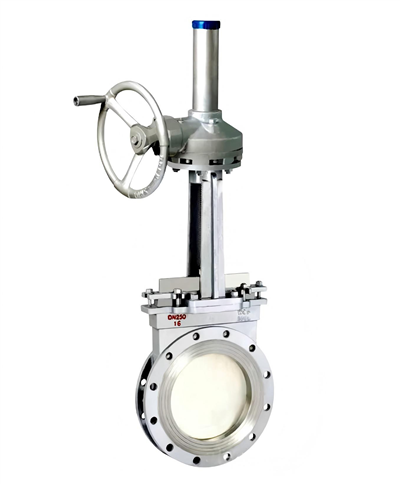
Product Introduction
Electro-hydraulic Knife Gate Valve - on-off for particles/fibers/viscous media. Electro-hydraulic for auto/remote/manual control. Sharp SS/CS blade gate, anti-blockage, reliable seal. Electro-hydraulic: stepless force, 80% efficiency, centralized/dangerous-area control. Integrated actuator (motor+pump+cylinder), no external unit, high thrust - ideal for DN300+. Blade cuts fibers, scrapes dust/tar, anti-clog slurry. Electric+manual handwheel, any-angle install. No-cavity body; O-ring seal opt.; rubber/PTFE/hard alloy. Explosion-proof Ex d, IP65/IP67. Compact. Body CS/SS/gray iron; gate CS/SS. DN50–500 (DN2000 custom), PN6/10/16, flange/wafer. GB/T 12234/MSS SP-81/API. For mining, paper, sewage, power, food, chemical. ISO/CE/SGS, 18mo warranty.
Product Features
1. Electro-hydraulic Integration Design: Combines electrical control and hydraulic transmission, with stepless force adjustment and stable operation, low impact force, and high transmission efficiency up to 80%. It can be centrally monitored or automatically controlled with computers/SCADA - realizing long-distance and high-altitude dangerous-area operation without on-site manual intervention. The integrated self-contained actuator (motor + hydraulic pump + cylinder + control valve + oil reservoir) requires no external hydraulic power unit - simplifying installation. Hydraulic provides high thrust in compact size - ideal for large-diameter DN300+ valves where pneumatic would be oversized and air-hungry.
2. Superior Cutting & Anti-Clogging Performance: The blade-shaped gate is made of high-quality stainless steel or carbon steel (optional hard alloy/Stellite/tungsten carbide overlay), which easily cuts fiber materials and scrapes off dust, tar, and other attachments on the sealing surface during closing - ensuring smooth opening and closing without blockage even for high-concentration slurry media. The sharp blade shears through fibrous media (wood pulp, waste paper, textile fibers) and particulate media (coal slurry, tailings, cement mixture) that would wedge and jam a conventional flat gate valve. The scraping action cleans the seat - maintaining sealing in tar/dust/viscous media.
3. Flexible & Reliable Operation: Equipped with both electric and manual operation modes. In case of power interruption, manual operation (handwheel via declutch mechanism) can open/close the valve - effectively controlling the medium and preventing accidents. The installation height and position are not limited - adapting to high-altitude installations, confined spaces, and outdoor locations. The manual override also enables precise positioning during commissioning and maintenance, and the declutch mechanism ensures smooth engagement/disengagement between electric and manual modes.
4. Excellent Sealing & Corrosion Resistance: The valve body has no cavity - eliminating material buildup and settling - and the gate rises/falls in the side guide groove, pressing tightly on the valve seat through the bottom lugs. An optional O-ring seal seat realizes two-way (bidirectional) sealing. Sealing surface options: rubber/EPDM (≤80°C, water/sludge), NBR (oil/grease), PTFE (≤180°C, chemical/corrosive), stainless steel/hard alloy (≤425°C, high-temp/abrasive) - ensuring no leakage across diverse media. The no-cavity design also reduces flow resistance and pressure drop.
5. Explosion-proof & Waterproof Options: The electric device can be customized as explosion-proof type (Ex d IIB T4 / IIC T4, excluding acetylene) for safe operation in flammable, explosive, or toxic gas environments - essential for chemical, coal, pharmaceutical, oil & gas. Standard products have IP65 protection (dustproof and rainproof); IP67 waterproof is available for outdoor or wet conditions (sewage treatment plants, outdoor mining, marine/offshore). Motor protection includes overload, overheat, phase-loss, and short-circuit protection (circuit breaker + contactor + thermal relay).
6. Compact & Easy Installation: The overall structure is compact, with short structural length, light weight, small installation space, and easy installation/dismantle - reducing installation and maintenance costs. The integrated electro-hydraulic actuator eliminates external hydraulic piping and power units - further simplifying installation. The valve can be installed in any orientation (vertical preferred for slurry service to prevent solids settling), and the compact face-to-face dimension fits between standard pipeline flanges.
Working Principle
The Electro-hydraulic Knife Gate Valve: motor → hydraulic pump → cylinder → stem → blade gate → seat → no-cavity body. Motor drives pump, solenoid directs oil to cylinder (4–16MPa, 80% efficiency), moving stem. Closing: blade shears fibers/particles, scrapes seat, lugs press gate - rubber/PTFE zero-leak or hard alloy Class IV (O-ring opt.). Opening: gate rises, full-bore flow. No-cavity body, side guides. Local/remote/PLC control, 4-20mA opt. Handwheel manual override; accumulator fail-safe opt. On-off only. DN50–500, PN6/10/16. Rubber ≤80°C, PTFE ≤180°C, hard alloy ≤425°C.
Application Scenarios
Mining & Iron and Steel Industry: Suitable for coal slurry, filter residue slurry, tailings, coal washing plant slurry, and iron/steel plant slag slurry; applied in underground slurry conveying, tailings discharge, concentrator feeding/discharging, coal washing slime, and steel plant slag pipelines. The sharp blade gate cuts through coal particles, ore fibers, and slag - preventing clogging in high-concentration mining slurry. The electro-hydraulic actuator provides high thrust for large-diameter DN300+ slurry pipelines and enables remote control in underground mining and high-altitude installations. The explosion-proof option (Ex d IIB/IIC T4) is essential for coal dust and explosive mining environments. Carbon steel body with rubber/NBR seat for general coal slurry; 316L with PTFE for acidic mine water; hard alloy gate for highly abrasive iron/steel slag.
Paper & Pulp + Food & Sugar Industry: Suitable for various concentrations of paper pulp, stock-water mixture, and fiber-containing media in papermaking (paper machine pulp supply, pulp screening/purification, waste paper treatment, bleaching systems); and beet washing water, syrup, juice, malt slurry, and food processing wastewater in food & sugar (sugar mill processing, syrup conveying, juice concentration, brewery malt slurry, food batching/filling). The sharp blade gate cuts wood pulp fibers, waste paper fibers, and plastic contaminants - preventing fiber wrapping and clogging. Food-grade stainless steel (304/316L) body with food-grade EPDM/PTFE seals meets FDA/3A standards; smooth electro-polished finish (Ra≤0.8μm) for hygienic service. The electro-hydraulic actuator matches high-speed paper machine production rates and enables precise batching/filling control.
Environmental Protection & Sewage Treatment: Used for wastewater, sludge, sewage, and clarified water containing suspended solids; applied in sludge lifting/return/discharge pipelines of sewage treatment plants, leachate conveying of waste incineration plants, and industrial wastewater treatment systems. The blade gate cuts through sludge flocs, hair, and fibrous debris - preventing clogging in sludge pipelines. The no-cavity design prevents sludge buildup and settling. EPDM seat for sewage/sludge; 304 body for corrosion resistance. IP67 waterproof option for outdoor/wet sewage plant environments. The electro-hydraulic actuator enables remote control in unmanned pump stations.
Power Station + Chemical & Pharmaceutical Industry: Used for ash slag slurry, ash conveying systems, FGD (flue gas desulfurization) limestone/gypsum slurry pipelines, and boiler blowdown in power stations; and viscous media, chemical slurry, pharmaceutical wastewater, API (active pharmaceutical ingredient) slurry, and emergency cut-off pipelines for dangerous media in chemical/pharma. The blade gate cuts through ash particles and gypsum slurry - preventing clogging in ash handling. Carbon steel body with EPDM/NBR for ash slurry; 316L with PTFE for FGD chloride-rich scrubber liquor. PTFE seat for corrosive acid/alkali; ATEX explosion-proof for flammable/toxic solvent environments. The electro-hydraulic actuator with fail-safe accumulator option provides emergency shut-off for hazardous media; manual override ensures safety during power outages.
Building Materials, Metallurgy & Other Industries: Used in drainage, heating, building materials (cement mixture, coating slurry, ceramic raw material slurry), metallurgy (metallurgical slag slurry), and printing & dyeing (dye slurry, printing and dyeing wastewater). Material options: carbon steel / stainless steel / gray cast iron body; gate: carbon steel / 2Cr13 / 304 / 316 stainless steel / hard alloy; seal: rubber / PTFE / stainless steel / hard alloy - selected per abrasion / corrosion / temperature requirements. OEM/ODM customization available for special sizes (up to DN2000), materials, connections, actuator types, and control systems.
Quality Assurance
Every Electro-hydraulic Knife Gate Valve is manufactured and tested per ISO 9001, CE, SGS, GB/T 12234, MSS SP-81, API 609, GB/T 13927/API 598. Raw materials: body MTR + tests, PMI SS; gate blade PT; castings RT/UT; dimensions checked. Assembly: alignment, smooth, O-ring, blade action verified. Actuator: motor, pump, cylinder, manual override, IP/ATEX tested. Electric: local/remote, protection, feedback. Pressure: shell 1.5×PN, seat 1.1×PN (zero-leak/Class IV). Cycle test 5 cycles (electric+manual). Hydraulic hold 30min, oil clean. Batch traceable. Ship with certs, reports, manual, diagrams. 18mo warranty. ATEX/FDA/3A on request.
FAQ
Q1: What is an electro-hydraulic knife gate valve, and when should I use it instead of pneumatic or electric?
A: An electro-hydraulic knife gate valve (also called electro-hydraulic knife valve) is an on-off/isolation valve with a sharp blade-shaped gate, actuated by an integrated electro-hydraulic actuator (electric motor + hydraulic pump + hydraulic cylinder + control valve + oil reservoir, all in one self-contained unit). It is designed for media containing suspended particles, fibers, and viscous materials - slurry, pulp, sewage, sludge, coal ash, mineral sand, viscous chemical slurry - where conventional valves clog. Use it instead of pneumatic when: (a) you need a large-diameter valve (DN300+) or high differential pressure - electro-hydraulic has the highest thrust-to-size ratio; pneumatic would require an excessively large cylinder and high air consumption; (b) there is no compressed air supply available at the installation site; (c) you need stepless force/speed adjustment and low impact (hydraulic cushions the stroke, preventing water hammer); (d) you need centralized/computer/SCADA control for long-distance, high-altitude, or dangerous-area operation. Use it instead of electric (multi-turn) when: (a) you need higher thrust for large sizes or high pressure (electric multi-turn requires large gearboxes and is slower); (b) you want faster operation for large valves. Choose pneumatic for fast on-off (0.5–10s), small/medium sizes, hazardous areas (ATEX), and fail-safe spring-return. Choose electric (multi-turn) for precise modulating, small/medium sizes, and no air/hydraulic supply. The electro-hydraulic actuator is self-contained - no external hydraulic power unit or piping required - making it simpler to install than a conventional hydraulic system. It is primarily for on-off/isolation; with optional 4-20mA positioner it can modulate, but continuous throttling of abrasive slurry accelerates gate/seat wear.
Q2: How does the electro-hydraulic actuator work, and why is it good for large-diameter valves?
A: The integrated electro-hydraulic actuator combines: (1) electric motor (AC380V 50Hz standard, custom voltage) drives (2) hydraulic pump (gear pump standard, vane/piston for high pressure), which pressurizes (3) hydraulic oil (anti-wear hydraulic oil standard, fire-resistant fluid custom); (4) solenoid directional valve directs oil to either the cap-end (close) or rod-end (open) of (5) hydraulic cylinder (double-acting); the cylinder converts hydraulic pressure into linear thrust - driving the stem/gate up (open) or down (close). Why it is good for large-diameter valves: hydraulic transmission provides very high thrust in a compact size - hydraulic pressure is typically 4–16 MPa (up to 25 MPa custom), so even a modest cylinder diameter generates enormous force. For a DN300+ knife gate valve with high differential pressure or heavy slurry, a pneumatic actuator would need a very large cylinder diameter and consume a lot of compressed air (requiring a large air compressor and piping), while an electric multi-turn actuator would need a large gearbox and be slow. The electro-hydraulic actuator delivers the required thrust in a compact, self-contained package. Additional benefits: stepless force adjustment (via pressure relief valve), low impact (hydraulic oil cushions the stroke, and a flow control/throttle valve adjusts opening/closing speed to prevent water hammer), up to 80% transmission efficiency, and self-contained design (motor + pump + cylinder + valve + oil reservoir in one unit - no external hydraulic power unit or piping required). The system includes: pressure relief valve (overload protection), flow control valve (speed adjustment), check valve (holds position), optional accumulator (fail-safe operation on power loss), and optional oil cooler/heater for extreme environments. Opening/closing time is adjustable via the flow control valve - typically 5–30 seconds depending on size (small 5–10s, medium 10–20s, large 20–30s+).
Q3: How does the blade gate prevent clogging with particle/fiber media?
A: Clogging is the #1 failure mode for conventional gate valves handling particle/fiber media - the electro-hydraulic knife gate valve solves this through a dual cutting + scraping action and no-cavity body design: (1) Sharp blade (knife) edge: the bottom of the gate is machined to a sharp, beveled cutting edge. As the gate descends to close, this edge shears through fibers, particles, and viscous attachments in the flow path - cutting through media that would wedge and jam a conventional flat gate valve. It handles particles up to 5–10mm diameter and fibrous media (wood pulp, waste paper, textile fibers, hair in sludge). (2) Scraping action: as the gate slides past the seat during closing, the gate surface scrapes off dust, tar, and other attachments that have accumulated on the sealing surface - cleaning the seat and ensuring a tight seal. This is especially valuable for tarry media, dust-laden gas, and viscous attachments that would coat a conventional seat and cause leakage. (3) No-cavity body: conventional gate valves have a cavity above the flow bore where the gate retracts when open - this cavity is a dead zone where particles and fibers settle, harden, and eventually prevent the gate from closing (jamming). The knife gate valve's no-cavity (or minimal-cavity) body eliminates this dead zone, so there is nowhere for solids to pack and seize the gate. (4) Side guide grooves + bottom lugs: the gate is guided by side grooves that maintain alignment and prevent deflection; when fully closed, bottom lugs press the gate tightly against the seat - ensuring positive sealing. (5) Straight-through full-bore flow: when open, the gate's central circular cutout aligns with the body bore, providing an unobstructed straight-through flow path with low pressure drop. Together these features ensure reliable, clog-free operation in the most difficult particle/fiber/viscous media - mineral slurry, pulp, sludge, cement slurry, food paste - without frequent manual cleaning.
Q4: What seat/seal materials are available, and what are the temperature and pressure ranges?
A: Seat/seal materials (selected per medium, temperature, abrasion, corrosion): (a) Rubber/EPDM - water, sewage, sludge, ≤80°C - standard for wastewater/water; good weathering and acid/alkali resistance; food-grade EPDM available (FDA/3A). (b) NBR (Nitrile) - oil, grease, hydrocarbons, ≤80°C - for petrochemical oil-based slurry. (c) PTFE - chemical, corrosive, acid, alkali, solvent, ≤180°C - standard for chemical/corrosive; excellent chemical inertness; food-grade PTFE available. (d) Viton/FKM - high-temperature oil, fuel, chemical, ≤200°C+ - custom. (e) Stainless steel / hard alloy - high-temperature (≤425°C), abrasive, steam - Class IV leakage (not zero leakage); hard alloy overlay (≥3mm) for extreme abrasion; Stellite overlay for high temperature; tungsten carbide custom. (f) Polyurethane (custom) - highly abrasive slurry, ore tailings. Soft seals (rubber/PTFE/Viton) provide zero leakage per API 598/ISO 5208; metal/hard alloy provides Class IV for high-temp/abrasive. Optional O-ring seat provides bidirectional sealing (standard is unidirectional). Pressure range: standard PN6/PN10/PN16 (0.6/1.0/1.6 MPa); custom PN25, PN40 (up to 4.0 MPa). Temperature range by seal: rubber ≤80°C, PTFE ≤180°C, hard seal (stainless/hard alloy) ≤425°C; custom high-temp (to 550°C+) and cryogenic (to -46°C). The limiting factors are the seal material, body material, and electro-hydraulic actuator (standard -20°C to 70°C environment; high-temp/low-temp actuator available custom with oil cooler/heater). Sizes: standard DN50–DN500 (NPS 2"–20"); custom DN15–DN2000 (NPS 1/2"–80"). The electro-hydraulic actuator is especially advantageous for large sizes (DN300+) due to its high thrust-to-size ratio; for very large sizes (DN1000+), a remote-mounted hydraulic power unit may be recommended. Always confirm your medium, temperature, pressure, and size when ordering.
Q5: Can it operate manually during a power outage, and what maintenance is required?
A: Manual operation during power outage: Yes - a handwheel manual override is provided as standard. The handwheel engages via a declutch mechanism: when declutched, the handwheel directly drives the stem via a screw mechanism - allowing manual opening/closing without electric power. This is a critical safety feature: it prevents accidents and allows medium control during power outages. For large sizes, a gearbox handwheel is provided to reduce operating torque. The handwheel also enables precise positioning during commissioning and maintenance. Maintenance: (1) Routine: inspect for external leakage (stem packing, body joints, hydraulic oil leaks), motor operation, hydraulic oil level/color/temperature, position indication, protection seals; cycle the valve periodically (at least once per month) to prevent gate seizure in slurry service. (2) Hydraulic system: check hydraulic oil level (top up if low), replace hydraulic oil per manufacturer recommendation (typically every 12–24 months or 2000 operating hours), check/replace oil filter, inspect oil cooler/heater (if equipped), check for oil leaks at cylinder/pump/valves/fittings. (3) Gate/seat replacement: flanged/wafer body allows removal from pipeline; replace gate, seat ring, guide sleeve, packing as a kit. (4) Packing replacement: upper stem packing (PTFE/graphite) replacement by removing actuator and yoke. (5) Blade edge: inspect for wear/damage - if dull, cutting performance degrades and clogging risk increases. Resharpen or replace the gate. (6) Motor: check insulation resistance annually, clean cooling fins, check bearings. The valve is for on-off/isolation primarily - do not leave partially open for extended periods in abrasive slurry (high-velocity partial flow erodes gate/seat). With proper maintenance, the electro-hydraulic knife gate valve provides years of reliable service in the harshest particle/fiber/viscous media applications.
Hot Tags: Electro-hydraulic Knife Gate Valve | DN50–500 | IP65/Explosion-proof | Slurry Pulp, China Electro-hydraulic Knife Gate Valve | DN50–500 | IP65/Explosion-proof | Slurry Pulp manufacturers, suppliers, factory, square port knife gate valve, air operated knife gate valve, Wholesale seated knife, good price automated gate valves, ss knife gate valve, 2 knife valve
| Item | Specification |
|---|---|
| Product Name | Electro-hydraulic Knife Gate Valve / Electro-hydraulic Knife Valve |
| Valve Type | Electro-hydraulically Actuated, Blade-Shaped Gate, On-Off/Isolation, Flanged/Wafer, Full-Bore, No-Cavity Body, Unidirectional (std) / Bidirectional O-ring (custom) |
| Design & Test Standard | Design: GB/T 12234, MSS SP-81, API 609 (opt.), DIN 3352 (opt.); Face-to-Face: GB/T 12221, MSS SP-81; Flange: GB/T 9113, ASME B16.5, DIN; Test: GB/T 13927, API 598, ISO 5208 |
| Nominal Diameter | DN50–DN500 standard (DN15–DN2000 customizable, NPS 2"–80"); Full-Bore standard, Reduced-Bore custom |
| Pressure Class | PN6, PN10, PN16 (0.6/1.0/1.6 MPa, standard); PN25, PN40 (custom); Shell test 1.5×PN, Seat test 1.1×PN |
| Operating Temperature | Rubber/EPDM seal ≤80°C; PTFE seal ≤180°C; Hard seal (SS/hard alloy) ≤425°C; Custom high-temp ≤550°C / cryogenic ≤-46°C; Environment -20~70°C (std actuator) |
| Applicable Medium | Slurry, pulp, sewage, sludge, coal ash, mineral sand, ore slurry, tailings, slag, viscous media, chemical slurry, food slurry, cement mixture, coating slurry, dye slurry, fibers, suspended particles, dust, tar |
| Body & Gate Material | Body/cover: Carbon Steel (std), Stainless Steel (304/316/316L), Gray Cast Iron, Ductile Iron (custom); Gate: Carbon Steel, 2Cr13, 304, 316 SS, Hard Alloy/Stellite/Tungsten Carbide overlay (abrasive/high-temp) |
| Seat/Seal & Sealing Type | Rubber/EPDM (≤80°C, water/sludge), NBR (oil), PTFE (≤180°C, chemical), Viton/FKM (high-temp oil), SS/Hard Alloy (≤425°C), Food-grade EPDM/PTFE (FDA/3A), Polyurethane (abrasive, custom); Soft seal zero leakage (std), Metal hard seal Class IV (custom); O-ring bidirectional (custom) |
| Actuation Type & Motor | Integrated Electro-hydraulic Actuator (motor + hydraulic pump + cylinder + control valve + oil reservoir, self-contained); Motor: AC380V 50Hz 3-phase (std), custom AC220/440/480/690V, DC24V, 60Hz; Power 0.37–15kW+ per size; Transmission efficiency up to 80%; Opening/closing 5–30s adjustable |
| Hydraulic System | Pressure 4–16 MPa (std), up to 25 MPa (custom); Gear pump (std), vane/piston (high-pressure custom); Anti-wear hydraulic oil (std), fire-resistant/synthetic/food-grade (custom); Accessories: pressure relief, flow control, check valve, solenoid directional, oil filter/level/temp gauge; optional oil cooler/heater/accumulator (fail-safe) |
| Control Mode & Feedback | Local push-button (std), remote PLC/DCS (discrete signals), 4-20mA modulating (custom), computer/SCADA, Profibus/Modbus/HART (custom); Position feedback: visual indicator (std), limit switches (4-2 SPDT), 4-20mA position transmitter (custom); Manual override: handwheel + declutch mechanism (std) |
| Connection & Installation | Flanged RF/FF (std), Wafer (std), Lug (opt.), Butt-weld (custom); Any orientation (vertical preferred for slurry); Flow: unidirectional (std) / bidirectional (O-ring, custom) |
| Protection & Explosion-proof | IP65 (std, dustproof/rainproof), IP67 waterproof (custom, outdoor/wet/marine), IP68 submersible (custom); Explosion-proof Ex d IIB T4 / IIC T4 (excl. acetylene), ATEX/IECEx (custom); Motor protection: overload, overheat, phase-loss, short-circuit |
| Certification & Warranty | ISO 9001:2015, CE, SGS (std); ATEX/IECEx, FDA/3A, API 609, PED, CRN, marine (optional); NDT: RT/UT/PT/MT/PMI/hardness; MOQ 1 pc; Delivery 25–40d (std) / 40–60d (custom); Warranty 18 months from shipment or 12 months from installation; Ship docs: MTR, pressure cert, dimensional/cycle/actuator/electric reports, oil cert, O&M manual, wiring/hydraulic diagrams, product cert |